Updated for 2026. A litter box routine has three parts: scooping, changing the litter completely, and washing the box. The animal-welfare and veterinary groups we read agree on the shape of it but not on every number, so this guide gives each group’s own figures and says whose they are. We do not average them. We do not recommend specific products here. For litter picks, see our best cat litter for odor control guide.
This is general information for cat owners, not veterinary advice. We have no in-house veterinary reviewer. If your cat’s litter-box habits change suddenly, mention it to your veterinarian.
How Often to Scoop
The sources are close on daily scooping and differ on whether once is enough. The ASPCA says to scoop and change your cat’s litter at least once a day. Humane World for Animals says to scoop waste daily. Cornell Feline Health Center says that with clumping litter you should remove feces and clumps daily and add clean litter as needed. International Cat Care sets a higher bar: the tray should be scooped out at least twice a day.
Humane World adds a reason to keep up with it: cats may avoid a box another cat has just used. International Cat Care says cats are less likely to use a litter tray that is already soiled.
How Often to Change the Litter Completely
Scooping removes waste. A full change empties the box, washes it and refills it. The figures below are each group’s own, and they depend on the litter type.
| Source | Full change or wash, as the source states it |
|---|---|
| ASPCA | Once a week, clean all litter boxes and completely replace the litter. |
| Humane World for Animals | Clay litter: replace twice a week. Clumping litter: replace every 2–3 weeks if scooped daily. Change sooner if you notice odors or wet, clumped areas. |
| International Cat Care | Clumping litter: completely clean out and wash the tray every 2–4 weeks. Non-clumping litter: weekly. |
| Cornell Feline Health Center (page updated January 2015) | No fixed interval. Litter should be changed often enough that it looks and smells dry and clean, and the more cats use the box, the more often this is needed. |
The numbers disagree, so pick the source whose litter type matches yours, or follow the schedule printed on your litter’s packaging. Whichever you follow, change sooner when the litter stops looking and smelling dry and clean. That is Cornell’s test, and Humane World gives the same advice for odors and wet clumps.
How to Wash the Box, Step by Step
The steps below combine what the named sources say. Where they differ on the cleaning product, the differences are listed after the steps.
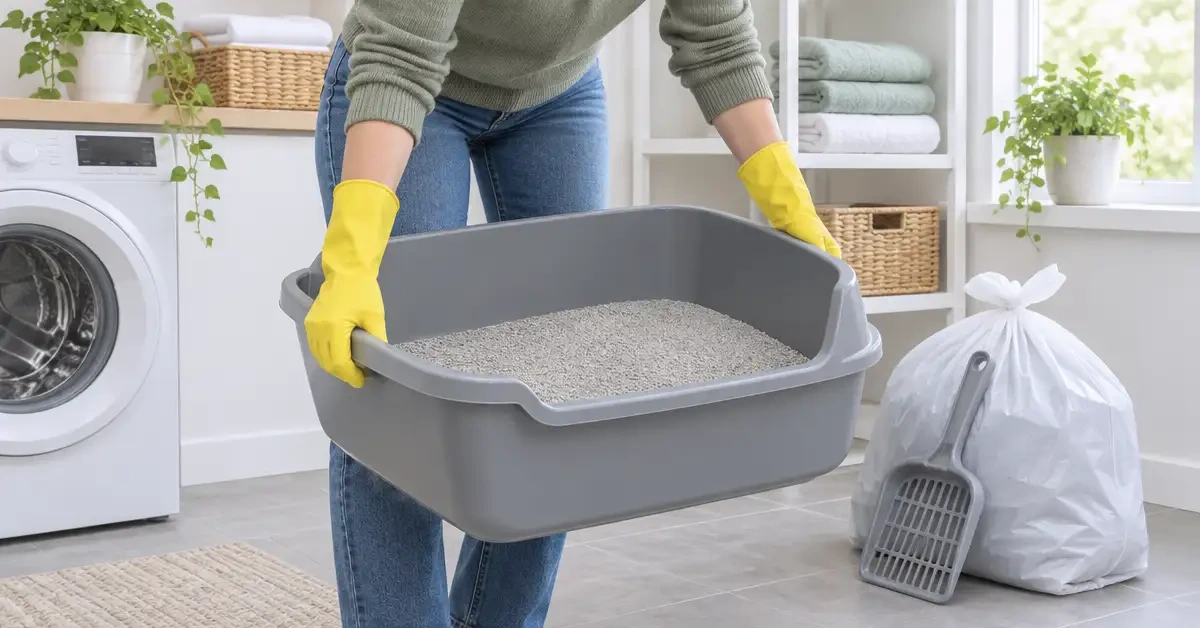
- Empty the box. Dump all of the old litter. The ASPCA’s weekly routine is to clean all litter boxes and completely replace the litter.
- Wash it. Use the product the sources name (see below). Cornell says to scrub the box with a gentle detergent.
- Rinse it. International Cat Care says to always rinse and dry the tray thoroughly before use.
- Dry it. Cornell’s sequence is scrub, dry, then refill with clean litter. International Cat Care also says to dry the tray.
- Refill to a shallow depth. The depth figures differ: International Cat Care says research shows cats prefer approximately 3 cm of litter. Humane World says most cats prefer about 2 inches. The ASPCA says to provide one to two inches rather than three to four inches. Cornell says one to two inches.
- Wash your hands. See the hygiene section below.
What to wash with, and what to avoid
- Mild or unscented soap. Humane World says to wash the box with mild dish soap each time you replace the litter. The ASPCA says to use warm water with unscented soap, baking soda or no soap. Cornell says gentle detergent. International Cat Care says hot water and biological detergent.
- Scented products. The ASPCA says the problem with scented cleaners is that your cat could develop an aversion to the scent. International Cat Care says heavily scented detergent should be avoided.
- Ammonia, citrus oils and harsh chemicals. Humane World says to avoid products with ammonia, citrus oils or harsh chemicals, because these can repel cats and may be toxic.
- Cloudy-in-water disinfectants. International Cat Care says some disinfectants, such as chloroxylenol or Dettol, which go cloudy in water, are toxic to cats.
We give no dilution or mixing instructions, because a household-chemical ratio is not something to improvise.
When to Replace the Box Itself
Cornell’s litter-box checklist says to replace old boxes that smell or are cracked. The page was last updated in 2015, so treat it as a general rule of thumb.
Cleaning With More Than One Cat
Cornell says the more cats using a box, the more often the litter needs changing. The ASPCA and Humane World recommend one box per cat plus one extra. International Cat Care recommends one tray per cat plus at least one extra, spaced out around the house. For the full setup, see our guide to how many litter boxes you should have.
Self-Cleaning Boxes Still Need Cleaning
A self-cleaning box changes who does the scooping, not whether the unit ever needs attention. We did not read any manufacturer’s cleaning instructions for this page, so check your own model’s manual for its drawer and wash schedule. What the groups we read do say is about cats: the ASPCA says many cats accept self-cleaning boxes readily, and that if a cat starts eliminating outside the box, to try a traditional box. Humane World says self-cleaning boxes can be intimidating to some cats, especially those used to traditional boxes. International Cat Care says these trays often make random movements or noises that can startle cats. If you are comparing models, see our automatic litter box guide.
Your Own Hygiene and Where the Box Goes
The CDC (page dated June 15, 2026) says to wash your hands with soap and running water after cleaning a litter box, even if you use a scoop to remove the waste. It also says to keep the litter box away from other animals, children and food preparation areas. Humane World says to keep boxes in quiet, low-traffic places away from food and water.
For disposal, follow the directions on your litter’s packaging and your local rules.
If the box needs replacing, our guides to litter boxes for multiple cats and enclosed and covered litter boxes cover the options. If the box is clean and the room still smells, see how to get rid of litter box smell.
Frequently Asked Questions
How We Researched This and Sources
This page draws on guidance from the ASPCA, Humane World for Animals, International Cat Care, Cornell Feline Health Center and the CDC. We read each page and describe what it says. We do not give medical advice and we do not recommend products on this page. Michael Probert, our author, writes from research, not clinical or veterinary expertise, and we have no in-house veterinary reviewer. Full editorial policy: How We Choose. For more on litter and gear, see our cat gear guide.
Sources: ASPCA, Litter Box Problems, Humane World for Animals, How to Litter Train a Kitten or Cat, International Cat Care, Choosing a litter tray for your cat, Cornell Feline Health Center, Feline Behavior Problems: House Soiling and CDC, Cats.