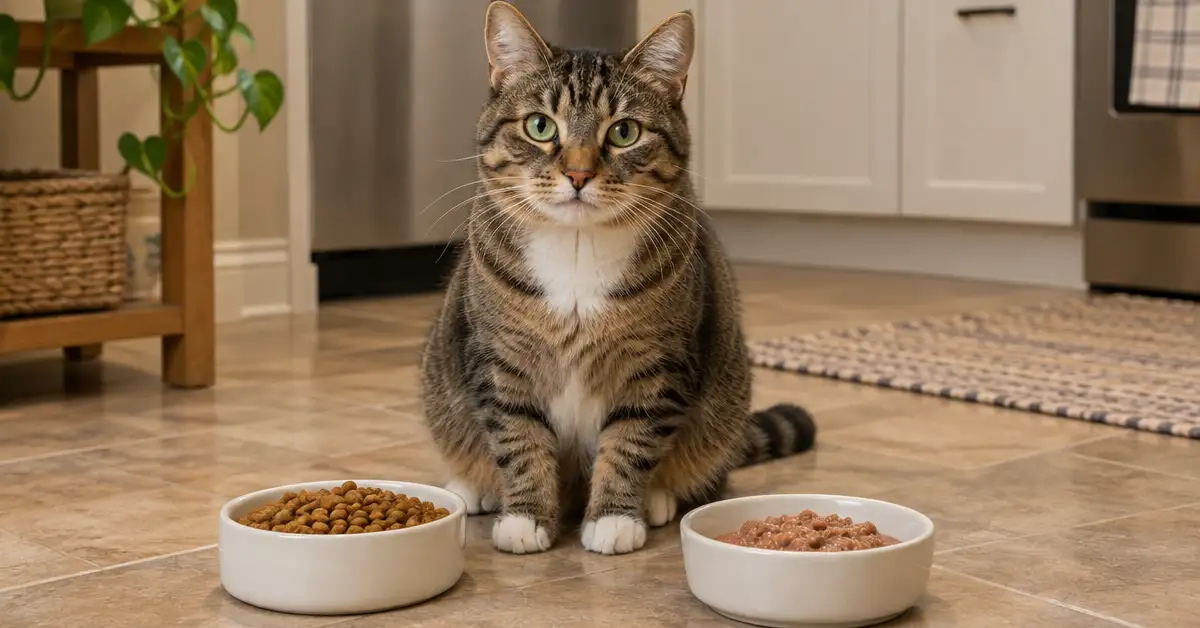
Updated for 2026. “Wet or dry?” is one of the first questions any new cat owner asks, and it rarely has a single right answer. The honest version is that both formats can support a healthy cat when the diet is complete and balanced — but they differ in ways that matter a lot for hydration, weight management, and certain medical conditions, and matter much less for others.
This is general information for cat owners, not veterinary advice. We are not veterinarians and have no in-house vet reviewer — any diet change for a cat with a diagnosed condition, or any cat showing signs of illness, should be made with your own vet, not from an article.
How We Researched This
This guide draws on the Cornell Feline Health Center’s feeding guidance, VCA Animal Hospitals’ client education materials, the 2021 AAHA/AAFP Feline Life Stage Guidelines and 2023 AAHA Senior Care Guidelines, a 1999 controlled trial and a 2020 cohort study on urinary diet outcomes (both peer-reviewed, indexed on PubMed/PMC), and additional veterinary and educational sources including PetMD, Chewy’s education library, VetLens, and Cat Specialists Australia. Most sources don’t carry a specific publication date on the page itself — where that’s the case, we attribute by organization name only rather than inventing one. Full policy: How We Choose.
Moisture and Hydration: The Biggest Physical Difference
The single clearest difference between wet and dry cat food is water content. Canned food generally runs at least 75% moisture, while dry kibble sits around 6–10% (Cornell Feline Health Center). Cats evolved as desert-adapted hunters that got much of their fluid from prey rather than from standing water, and many still don’t fully make up the difference by drinking more when fed a dry-only diet (Cornell Feline Health Center). That means a cat eating mostly kibble depends more heavily on actively drinking enough water, while a cat eating wet food gets a meaningful share of its daily fluid straight from meals.
This matters beyond simple hydration. More dilute urine is generally considered less likely to concentrate the minerals that contribute to feline lower urinary tract disease (FLUTD), which is why moisture is such a recurring theme in urinary-health guidance (VCA Animal Hospitals). We cover that connection in more depth in the health section below — and separately, in our guide to cat water fountains, for households whose cat simply doesn’t drink enough from a bowl regardless of food type.
Protein, Carbohydrates, and Calorie Density
Wet and dry foods also tend to differ in macronutrient makeup, though there’s real overlap and plenty of exceptions. Canned diets often run higher in protein and lower in carbohydrate than dry food, partly because they lean on meat and meat by-products for palatability (VCA Animal Hospitals). Dry food frequently uses more plant-based ingredients, which can push carbohydrate content up (Cornell Feline Health Center). As obligate carnivores, cats need meat-derived nutrients like taurine and have limited use for a carbohydrate-heavy diet, so protein quality matters in either format (2021 AAHA/AAFP Feline Life Stage Guidelines).
That said, veterinary sources are consistently more measured about this than online chatter suggests: concerns about dry food’s carbohydrate content are often exaggerated, and it’s entirely possible to keep a cat lean on kibble or let one become overweight on canned food, depending on how carefully calories are managed (Veterinary Practice News). The nutrient panel on the specific product you’re buying matters more than a blanket “wet is healthier” assumption.
Moisture content also drives calorie density. Because canned food is mostly water, a cat can eat a larger volume for the same number of calories as a much smaller amount of kibble (VCA Animal Hospitals). That can help with satiety in cats prone to weight gain, while dry food’s higher calorie density can be genuinely useful for underweight cats or those with a small appetite who need more calories in a smaller volume (VCA Animal Hospitals).
Palatability and Feeding Behavior
Texture preferences often form early and can be stubborn. Some cats strongly prefer one format over the other from kittenhood onward, which is part of why the 2021 AAHA/AAFP guidelines recommend introducing a variety of textures — kibble, pâté, chunks in gravy — while a cat is still young, so that a later medical need for more wet food (or more dry food) doesn’t run into an entrenched preference (2021 AAHA/AAFP Feline Life Stage Guidelines). Canned food’s aroma and texture can also be genuinely useful for tempting a picky eater, warming slightly to increase smell, or hiding medication (VCA Animal Hospitals).
Urinary Tract Health: Where the Evidence Is Strongest
Urinary health is the area where the wet-versus-dry difference has the most direct clinical support. Feline idiopathic cystitis (FIC) — the most common form of FLUTD — is closely linked to stress and dehydration, and higher-moisture diets are widely cited as one of the most direct, non-prescription ways to dilute urine and reduce recurrence (Omnipet Hub; VCA Animal Hospitals).
The clinical evidence here isn’t new, but it’s real: a controlled trial published in the Journal of the American Veterinary Medical Association followed 54 cats with a history of idiopathic cystitis for up to a year on either the dry or canned version of the same urinary-acidifying diet. Signs did not recur in 16 of 18 cats on the canned version, versus 17 of 28 on the dry version — a meaningful difference favoring the wet formulation, even though the same underlying diet formula was used in both (JAMVA, 1999, peer-reviewed). A later cohort study in the Journal of Veterinary Internal Medicine found that a therapeutic urinary stress diet cut short-term FIC recurrence substantially — but in that particular study, format (wet vs. dry vs. combination) wasn’t itself linked to outcome once the therapeutic formula was accounted for, suggesting the specific diet’s design can matter as much as moisture alone over a short follow-up window (JVIM, 2020, peer-reviewed).
None of this makes wet food a substitute for a vet visit. FLUTD has multiple possible causes — stones, infections, anatomical issues — that need a proper work-up. A cat straining in the litter box, urinating outside it, or showing blood in the urine needs prompt veterinary attention, after which diet changes can be discussed as part of a plan (VCA Animal Hospitals; Omnipet Hub).
Kidney Health and Chronic Kidney Disease
Chronic kidney disease (CKD) is common in older cats, and hydration is central to how it’s managed. CKD reduces a cat’s ability to concentrate urine, so dietary moisture becomes more important, not less — several veterinary sources describe wet renal diets, with moisture in the 70–80% range, as strongly preferred over dry kibble for cats with the condition, and recommend introducing prescription renal diets at the stage a vet identifies via bloodwork (VetLens; Cat Specialists Australia). Where a cat won’t eat wet food, adding water to kibble and encouraging drinking (multiple bowls, a fountain) is a fallback, not a first choice.
This is squarely a “talk to your vet” area rather than a do-it-yourself switch: CKD management also involves phosphorus and calcium targets that a specific renal diet is formulated around, and self-directed changes without diagnosis can do more harm than good.
Weight Management and Diabetes Risk
Because canned food is less calorie-dense by volume, it can make portion control feel less restrictive for a cat that’s used to a full bowl — a genuinely useful lever for weight management (VCA Animal Hospitals; HousePetAuthority). Free-feeding dry food, by contrast, is one of the more well-documented contributors to overeating and weight gain, simply because it’s easy to lose track of how many calories are actually available in a bowl that’s always full (Cornell Feline Health Center).
On diabetes specifically, the honest answer is that the evidence is suggestive rather than settled: canned diets’ generally lower carbohydrate and higher protein profile is thought by some clinicians to help, but veterinary sources are careful to note more research is needed and that cats can process carbohydrate in both formats (VCA Animal Hospitals). For a cat already diagnosed with diabetes, your vet will typically factor in insulin regimen, weight, and appetite when recommending a specific diet — wet or dry — rather than treating format as the primary lever.
Dental Health: Does Dry Food Really Clean Teeth?
This is one of the most common claims about kibble, and current veterinary consensus treats it as oversold for ordinary dry food. Only dental diets specifically formulated and tested to Veterinary Oral Health Council (VOHC) standards have demonstrated meaningful plaque reduction — a standard bag of kibble, without that seal, isn’t shown to meaningfully clean teeth on its own (VCA Animal Hospitals). Canned food, for its part, doesn’t carry dental-health claims at all. Real oral health still depends on regular veterinary dental checks and, where a cat tolerates it, home brushing — not on the crunch of a kibble (2021 AAHA/AAFP Feline Life Stage Guidelines).
Cost, Storage, and Feeding Logistics
Dry food is generally the more budget-friendly option per calorie and stores easily in a sealed container for weeks, which is part of why it’s the default for free-choice feeding and for automatic hopper feeders (Cornell Feline Health Center; Chewy Education). Wet food is more expensive per calorie — you’re partly paying for water weight — and far more perishable: an open can needs refrigeration and should generally be used within a few days, and food left out in a bowl should be picked up within about two hours (sooner in a hot room) rather than left to sit (VCA Animal Hospitals; PetMD).
That perishability is also why wet food doesn’t work in a standard dry-kibble hopper feeder — see our automatic cat feeder guide for portion-controlled dry-food options, or our automatic wet and canned food feeder guide for the smaller category of feeders built with cooling or ice-pack compartments specifically to keep wet meals safe until they’re dispensed. Whichever type you use, a feeder only helps if the portions loaded into it match a calorie target you’ve actually worked out — see our feeding chart by weight and age for a starting point.
Mixed Feeding: Combining Wet and Dry Without Doubling Calories
For many households, the practical answer isn’t “wet or dry” but some combination of both. Adding wet food to an existing dry diet is a straightforward way to increase water intake, and a commonly cited starting ratio is roughly 70% dry to 30% wet by calories, adjusted toward more wet food for cats that are overweight or prone to urinary issues (Chewy Education). The one rule that matters most: wet and dry need to share one daily calorie budget, not stack as two full portions — work out your cat’s total target first (our feeding chart walks through this), then split it between formats rather than adding a full serving of each. Transition gradually over a week or more, and treat wet portions with the same spoilage rules as feeding wet food alone — remove uneaten food after a couple of hours rather than leaving it mixed into a dry bowl all day (Chewy Education; PetMD).
Kittens, Seniors, and Cats with Health Conditions
Kittens have high energy needs and benefit from exposure to a mix of textures early on, which both keeps options open later and helps meet their growth requirements — either format works as a foundation as long as it’s a complete, balanced kitten formula (2021 AAHA/AAFP Feline Life Stage Guidelines; VCA Animal Hospitals). Senior cats often benefit from the hydration boost of more wet food as kidney function and thirst response can decline with age, though energy needs vary enough by individual that a blanket rule isn’t useful — a vet visit that includes a body-condition assessment is more reliable than a chart (2021 AAHA/AAFP Feline Life Stage Guidelines; 2023 AAHA Senior Care Guidelines).
For cats with a diagnosed condition — FLUTD, CKD, diabetes, or significant obesity — the honest framing is that “wet versus dry” stops being a lifestyle preference and becomes part of a medical plan your vet should be driving, usually via a specific therapeutic diet available in one or both formats. None of the general guidance above is a substitute for that individualized plan.
The Bottom Line
Neither format is universally “better.” Wet food’s moisture advantage is genuinely well-supported for hydration, urinary health, and weight management, particularly for cats that don’t drink much on their own — while dry food remains a convenient, cost-effective, nutritionally complete option for plenty of healthy cats when portions are measured rather than left out all day. For most households, some mix of the two — sized to a real calorie target and adjusted for your specific cat’s health — beats picking a side.
Frequently Asked Questions
Methodology & Sources
This guide is research-led, not based on hands-on veterinary practice or clinical testing. Michael Probert, our author, is a longtime multi-cat owner writing from research and lived experience, not clinical or veterinary expertise — see our About page. We have no in-house veterinary reviewer; nothing here is a substitute for professional veterinary advice for an individual cat.
Sources: Cornell Feline Health Center, Feeding Your Cat, VCA Animal Hospitals, Dry, Canned, or Semi-Moist Food Choices for Cats, VCA Animal Hospitals, Canned vs. Kibble Diets: Pros and Cons, Clinical evaluation of urinary acidification diets in idiopathic cystitis, PubMed (peer-reviewed), Effect of a therapeutic urinary stress diet, PMC (peer-reviewed), Omnipet Hub, Cat Urinary Health, VetLens, Best Cat Food for Kidney Disease, Cat Specialists Australia, Dietary Management of Cats with CKD, Veterinary Practice News, Canned or Dry Food: What’s Better for Cats?, PetMD, How Much Wet Food Should I Feed My Cat?, Chewy Education, The Benefits of Mixing Wet and Dry Cat Food, HousePetAuthority, Wet vs. Dry Cat Food, 2021 AAHA/AAFP Feline Life Stage Guidelines, and 2023 AAHA Senior Care Guidelines, Disease Management: Nutritional.
See our best automatic cat feeders and best automatic wet food cat feeders guides for verified devices, our feeding chart by weight and age for portion sizing, or our full cat gear guide for everything else a cat owner needs.