Updated for 2026. A plain automatic hopper feeder solves scheduling and portion control for dry kibble — but wet and canned food is a genuinely different mechanical problem. Once a compartment of wet food is exposed to room air, the clock starts on food safety, not just freshness: the FDA’s own pet food handling guidance says an opened can or pouch shouldn’t sit out for more than 2 hours (just 1 hour above 90°F). Below, we cover 7 verified automatic feeders built specifically for wet or canned food — cooling mechanism, sealed rotating trays, and cleaning burden included — rather than a dry-food hopper wearing a “works with wet food too” label.
This guide covers a different segment than our automatic cat feeders guide, which focuses on dry-kibble portion control, RFID multi-cat gating, and camera monitoring. Here we evaluate feeders on the things that actually matter for wet food specifically: how (and how well) each one keeps food cool between meals, whether it uses a sealed rotating tray or an open bowl, how it holds up for vet-directed feeding schedules, and how much harder it is to clean than a dry hopper. One product below, the Cat Mate C500, also appears on our dry-feeder guide — there, we cover its portion-control timer; here, we cover only its ice-pack cooling and carousel-sealing mechanism, so the two write-ups don’t repeat each other.
How We Chose
Every feeder below was checked against its manufacturer or major-retailer listing page (the brand’s own site, Chewy, or Amazon) for current availability, stated cooling mechanism, and compartment count before inclusion. This is a genuinely narrower niche than dry-food hoppers — several products marketed as “wet food compatible” turned out on closer inspection to have no cooling mechanism at all, and we excluded those rather than pad the list. Our October 2026 search of the US Consumer Product Safety Commission (CPSC) recall database found no recall for any wet-food feeder recommended below. Full policy: How We Choose.
Why Wet Food Needs a Different Kind of Feeder
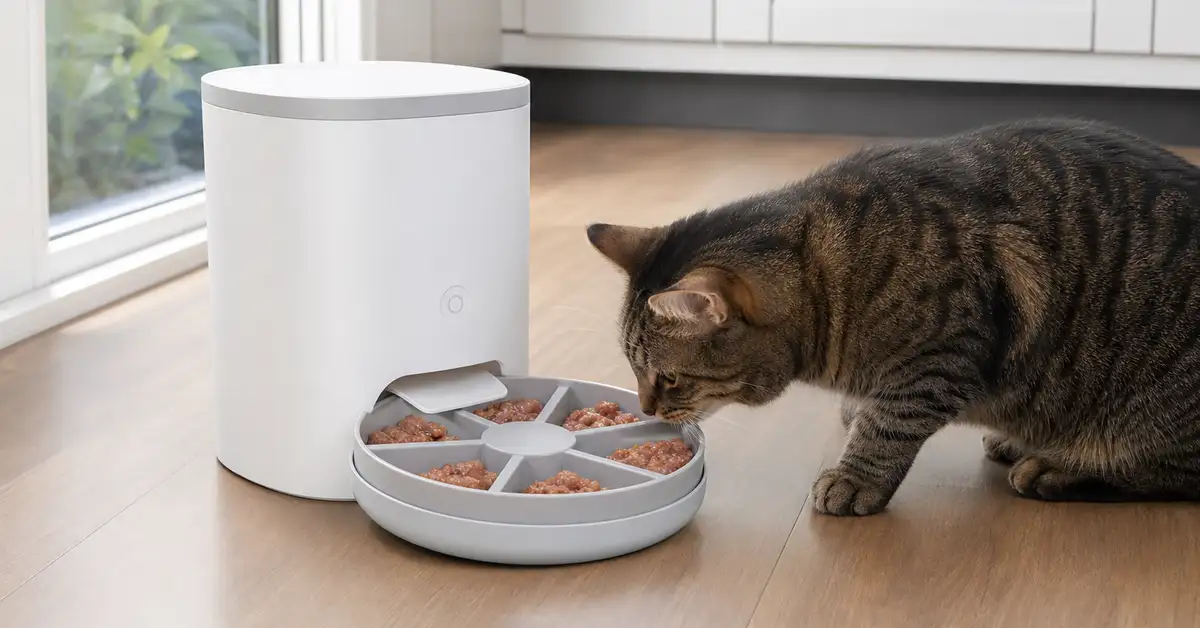
The FDA’s guidance on safe pet food handling is direct: promptly refrigerate or discard unused canned or pouched pet food, and don’t leave an opened can out at room temperature for more than about 2 hours — a window that shrinks to roughly 1 hour once the room hits 90°F. A dry-kibble hopper never runs into this problem, because dry food doesn’t spoil on the same timeline. A wet-food automatic feeder does — if you program a feeder to open a compartment of pate or gravy-style food at 7am and the next scheduled meal isn’t until 6pm, that food has sat exposed for eleven hours, several times longer than the FDA’s own room-temperature window, unless the feeder actually does something to keep it cold. That’s the entire reason the products below exist as a separate category from a dry hopper: a cooling mechanism (an ice pack, a refrigerated compartment) or a sealed, rotating tray that keeps unopened compartments closed until feeding time isn’t a nice-to-have feature here — it’s the product’s whole job.
Ice Packs vs. Active Refrigeration: What Actually Buys You More Time
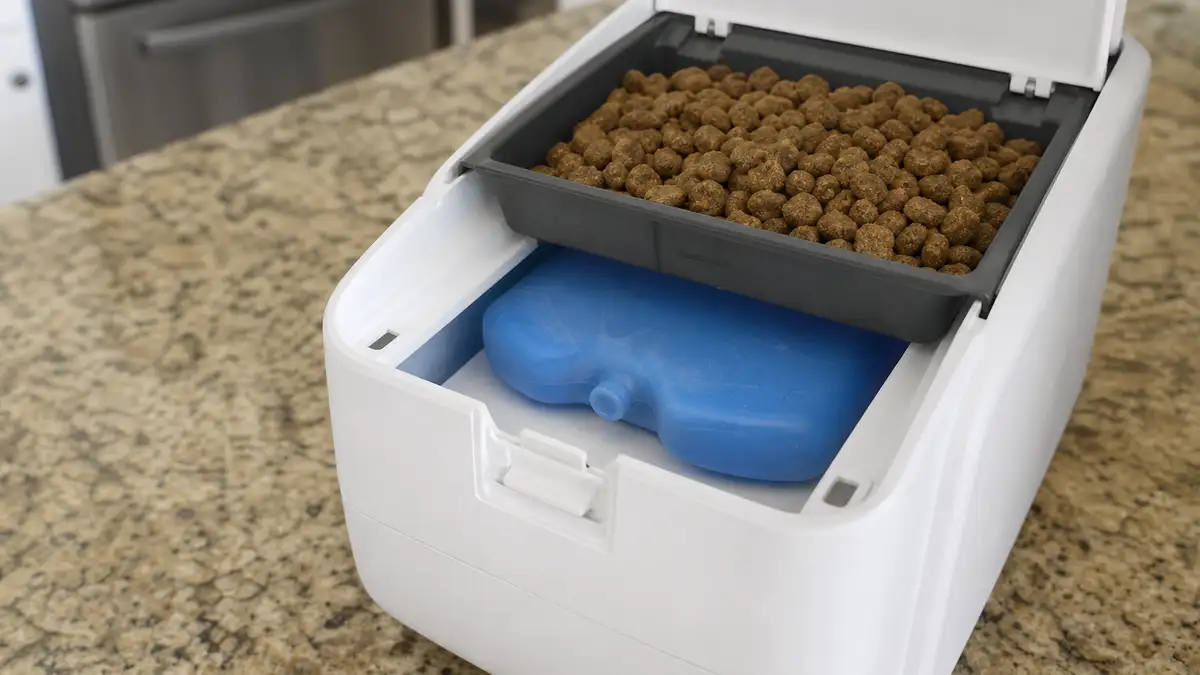
Two distinct cooling approaches show up across the feeders below, and they are not interchangeable. Ice-pack feeders (Cat Mate’s C-series, Casfuy’s F13, iPettie’s Brioche/Donut line, WOPET’s FT60, Trixie’s TX2) tuck one or more reusable freezer packs into a compartment beneath the food tray. Manufacturers commonly claim these keep food cool for 6–24 hours depending on the model and how many ice packs it holds, but that figure assumes the pack is fully frozen at the start of the cycle and the room isn’t unusually warm — real-world reviews of these feeders describe a more conservative 8–12 hour practical window in a normal home, shorter in summer. Active refrigeration (PETLIBRO’s Polar line, using semiconductor/Peltier cooling) is the newer, higher-cost approach: it actively chills the tray to a stated temperature rather than relying on a pack that slowly warms, and manufacturer claims of multi-day freshness (PETLIBRO states up to 3 days) are more defensible because the mechanism doesn’t degrade the way a thawing ice pack does. Neither approach extends the FDA’s 2-hour guidance for food that’s actually been opened to room air continuously — the honest way to read either claim is “this buys meaningfully more safety margin than an uncooled bowl,” not “this makes the FDA’s window irrelevant.”
Cleaning a Wet-Food Feeder Is a Bigger, Different Job Than a Dry Hopper
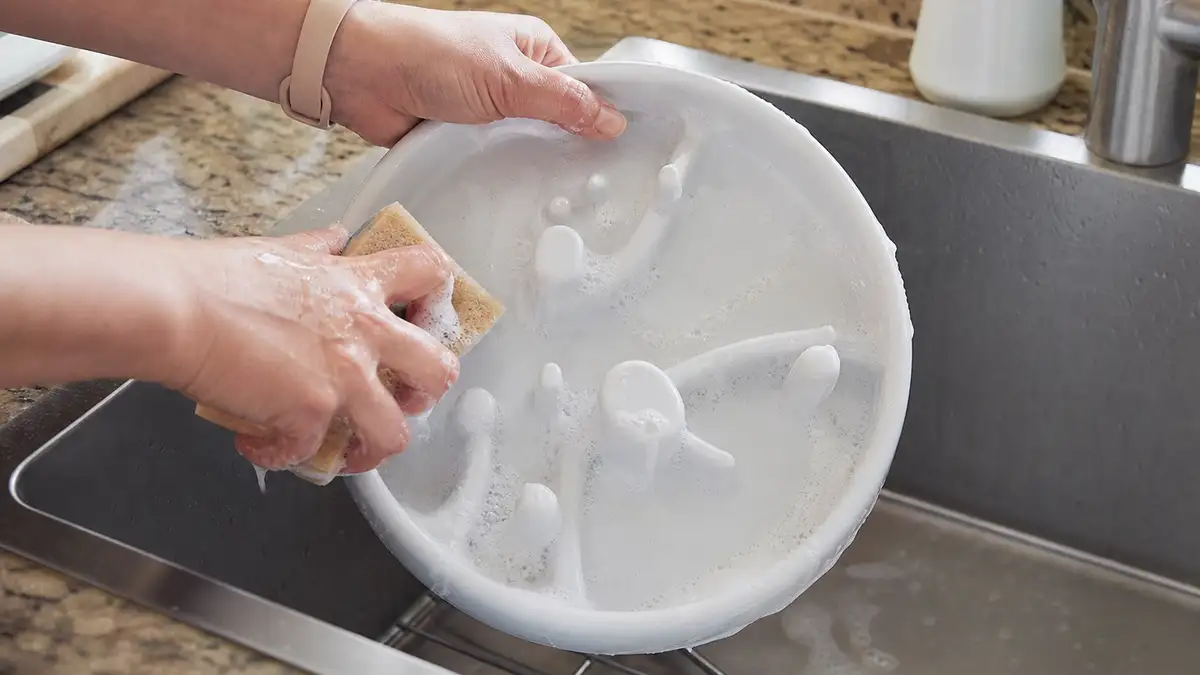
Dry kibble leaves behind dust and light oily residue that builds up slowly. Wet food residue is a different, faster-developing problem: it can dry onto a tray within hours, attracts odor and insects noticeably faster, and — on a rotating-tray design — can gum up the mechanism that rotates the next compartment into place if it isn’t cleaned regularly. Every feeder below has a removable tray; most manufacturers state their trays are dishwasher-safe, but always check the specific model’s own care instructions, since a tray with an integrated ice-pack compartment sometimes has hand-wash-only sections. Plan on cleaning a wet-food feeder’s tray after every full cycle, not on the “whenever you remember” schedule that’s more forgivable with a dry hopper.
Transparency first: This guide contains affiliate links. If we’re enrolled in an affiliate program, we may earn a commission at no extra cost to you — it never affects how we research or rank. Read our full affiliate disclosure policy.
1. PETLIBRO Polar Wet Food Feeder — Best Overall Wet-Food Feeder
What it is: A WiFi-connected, stainless-steel-tray feeder using semiconductor (Peltier) refrigeration rather than an ice pack, holding 3 separate meals in an extra-wide tray designed to reduce whisker fatigue.
Best for: Households that want the strongest available cooling mechanism in this category and are comfortable with an app-controlled, higher-cost feeder.
- Active semiconductor cooling chills the tray directly rather than relying on a thawing ice pack
- Manufacturer states meals stay fresh for up to 3 days, and the current meal is allowed to warm to room temperature for about 30 minutes before feeding for better palatability
- Food-grade stainless-steel tray resists odor retention better than plastic
Pros: The only feeder in this guide using active refrigeration instead of a passive ice pack, which is a genuinely different (and more consistent) cooling mechanism; app scheduling and remote monitoring; stainless steel is easier to keep odor-free long-term than plastic trays.
Cons: Highest price band in this guide; only 3 meal compartments, fewer than several ice-pack rivals; depends on a stable home WiFi connection and power outlet (not a cordless/battery design).
Price band: $$$$ (premium)
Evidence: Manufacturer listing, PETLIBRO.
2. Casfuy F13 Smart 6-Meal Feeder with 4 Ice Packs — Best Cooling/Ice-Pack System
What it is: A cordless, rechargeable 6-compartment rotating-tray feeder built around four separate ice packs rather than the one or two most ice-pack feeders include.
Best for: Households wanting the longest practical ice-pack cooling window in this guide, or a feeding plan from your vet that calls for smaller, scheduled meals.
- Four ice packs (most of any feeder in this guide) with a manufacturer claim of keeping food cold for up to 24 hours
- 6 compartments allow finer-grained meal scheduling than a 3- or 5-meal design
- Cordless, rechargeable battery rated for up to 3 months per charge, so a power outage doesn’t interrupt a diet schedule
Pros: Most ice-pack redundancy of any model here, which matters most for the meals scheduled furthest from feeding time; battery-first design keeps a strict schedule running through a power cut; BPA-free food-grade construction.
Cons: No active refrigeration — still an ice-pack system, so its real-world window (like every ice-pack feeder here) runs shorter than the headline claim in a warm room; 6 small compartments hold less per meal than a 3- or 5-compartment design built for larger portions.
Price band: $$ (mid-range)
Evidence: Manufacturer/retailer listing, Chewy.
3. Cat Mate C500 Digital 5-Meal Feeder — Best Rotating Tray/Carousel (Wet-Food Angle)
What it is: The same five-compartment mechanical-timer carousel feeder covered on our automatic cat feeders guide for its no-app portion control — evaluated here strictly on its carousel-sealing and ice-pack cooling mechanism, not its scheduling (see that guide for the portion-control angle).
Best for: Owners who specifically want a sealed, tamper-resistant rotating tray for wet food — each unopened compartment stays sealed under the lid, not sitting exposed the way a static multi-bowl design does.
- Tamper-resistant lid physically covers every compartment except the one currently due, unlike an open dual-bowl feeder
- Ice-pack tray sits beneath the compartments to slow spoilage between scheduled openings
- Runs on batteries with no WiFi dependency, relevant if the feeder’s location has poor signal
Pros (wet-food mechanism only): The rotating-carousel design means only one compartment is ever exposed to air at a time — every other meal stays sealed under the lid until its own turn, which a static open-bowl design can’t replicate; genuinely simple to operate with no app required.
Cons (wet-food mechanism only): The single ice pack sits mainly under the first, “immediate” compartment rather than evenly under all five, so later-scheduled meals get less cooling benefit than the first one — worth knowing if your schedule spans a full day.
Price band: $ (budget)
Evidence: Manufacturer/retailer listing, Chewy.
4. iPettie Brioche 6-Meal Cordless Feeder with 2 Ice Packs — Best for Vet-Directed Small-Meal Schedules
What it is: A cordless, dual-power (battery or plug-in) 6-compartment rotating-tray feeder with two ice packs, built around a circular tray with each compartment individually sealed until its scheduled time.
Best for: Cats on a feeding plan from your vet that calls for smaller, more frequent scheduled meals rather than one or two large ones — ask your vet about the right schedule before programming any feeder.
- 6 compartments support more, smaller scheduled meals than a 3- or 5-meal feeder
- Dual power supply (battery backup plus a plug-in option) keeps a strict medical feeding schedule running through a power outage
- Two ice packs help slow spoilage between the more closely-spaced meals of a vet-directed feeding plan
Pros: The 6-meal granularity is a genuine fit for diets that call for frequent small portions rather than fewer large ones; dual power is a real safeguard for a medical feeding schedule specifically; quiet operation reported across owner reviews.
Cons: Two ice packs is fewer than the Casfuy F13’s four, so its real-world cooling window runs shorter, reported around 6–8 hours per ice pack in owner reviews; smaller per-compartment capacity than a 3- or 5-meal design.
Price band: $$ (mid-range)
Evidence: Manufacturer listing, iPettie.
5. WOPET FT60 Automatic Feeder for Wet Food — Best Simple Ice-Pack Feeder
What it is: A straightforward automatic feeder built specifically for wet and canned meals, with a single ice-gel pack tucked under the tray and a 48-hour-advance programmable timer.
Best for: Owners who want a no-frills, purpose-built wet-food feeder without stepping up to a multi-ice-pack or app-connected model.
- Ice gel pack sits directly beneath the tray to help keep canned or pouched meals fresh
- BPA-free, dishwasher-safe trays
- Timer programs up to 48 hours in advance
Pros: Purpose-built for wet food specifically, rather than a dry-food design retrofitted with an ice-pack afterthought; straightforward lock-and-set operation; dishwasher-safe tray simplifies the heavier cleaning burden wet food creates.
Cons: Single ice pack, so less cooling redundancy than the Casfuy F13’s four-pack design; no app or remote monitoring.
Price band: $$ (mid-range)
Evidence: Manufacturer listing, WOPET.
6. Cat Mate C300 3-Meal Feeder with Ice Pack — Best Budget
What it is: A smaller, three-compartment sibling to the C500 above, with one immediate meal and two timed, sealed compartments, plus a single ice pack.
Best for: Single-cat households on a tight budget that want basic sealed-compartment cooling without paying for a 5- or 6-meal design they don’t need.
- Three large compartments, each holding up to ¾ lb of wet, dry, or mixed food
- Digital timer programs up to two scheduled meals plus an immediate one
- Runs roughly 12 months on 3 AA batteries
Pros: Lowest price band of any wet-food-capable feeder in this guide; large per-compartment capacity suits a single cat’s full meals rather than small snacks; simple digital timer with no app to configure.
Cons: Owner reviews consistently note the ice pack sits mostly under the first “immediate” compartment, so the two scheduled meals get less cooling benefit — the same limitation as its C500 sibling, just with fewer total compartments to spread it across; only 2 truly scheduled meals despite being marketed as “3-meal.”
Price band: $ (budget)
Evidence: Manufacturer/retailer listing, Amazon.
7. TRIXIE TX2 Two-Bowl Automatic Dispenser — Best for Two Cats
What it is: The simplest mechanism in this guide: two independent, individually-timed bowls (each up to 48 hours in advance) with their own included ice packs, rather than a single rotating multi-meal tray.
Best for: Two-cat households that want each cat’s own sealed, cooled portion without needing more than one scheduled meal per bowl.
- Two separate lids and timers, so each bowl can be set independently
- Includes ice packs to help keep wet or fresh food cooler until the lid opens
- Dishwasher-safe bowls; non-slip rubber feet keep the base in place
Pros: The two-bowl, two-timer layout is a genuinely simple fit for two cats that each need one sealed, cooled portion, without paying for a 5- or 6-meal carousel neither cat needs; dishwasher-safe parts ease the wet-food cleaning burden.
Cons: Only one scheduled opening per bowl, so it doesn’t suit a multi-meal-per-day schedule the way a rotating-tray design does; two static bowls (not a sealed carousel) means both are exposed to air from the moment the feeder is set, not just at feeding time.
Price band: $ (budget)
Evidence: Manufacturer/retailer listing, Chewy.
Frequently Asked Questions
Non-Cannibalization Note
One product on this page, the Cat Mate C500, also appears on our automatic cat feeders guide. The two write-ups deliberately don’t repeat each other: the dry-feeder guide evaluates the C500 on its no-app portion-control timer, while this guide evaluates it only on its carousel-sealing and ice-pack cooling mechanism for wet food. No other product on this page appears on the dry-feeder guide.
Methodology & Sources
Product specifications above are drawn from each manufacturer’s or retailer’s own published listing, linked in the Evidence line under each pick, cross-referenced against independent owner reviews where a direct manufacturer spec wasn’t published (noted in-line above). Food-safety guidance is drawn from the FDA’s own pet food handling recommendations. Our October 2026 search of the US CPSC recall database found no recall for any wet-food feeder recommended above. Michael Probert, our author, is a longtime multi-cat owner writing from research and lived experience, not clinical or veterinary expertise — see our About page. We have no in-house veterinary reviewer, and none of the products above were tested hands-on for this guide; this is research-led buying guidance, not a lab test. Full editorial policy: How We Choose.
Sources: FDA, Tips for Safe Handling of Pet Food and Treats, and manufacturer/retailer listings linked throughout.
See our full cat gear guide for everything else a new cat parent needs, or our automatic cat feeders guide for dry-food portion control and multi-cat RFID gating.