Updated for 2026. “How much should I feed my cat?” doesn’t have one universal answer — it depends on your cat’s weight, age, neuter status, and how many calories are actually packed into whatever food is in your cupboard. This guide translates veterinary nutrition guidance into practical weight-band charts for dry and wet food, covers how meal frequency should change from kitten to senior, and walks through the special cases (overweight, post-spay/neuter) where a generic chart isn’t enough on its own.
This is general information for cat owners, not veterinary advice. We are not veterinarians and have no in-house vet reviewer — every cat’s ideal diet should ultimately be confirmed with your own vet, especially if your cat is overweight, recently spayed/neutered, or a senior.
How We Researched This
This guide draws on the Cornell Feline Health Center’s feeding guidance, the 2021 AAHA Nutrition and Weight Management Guidelines for Dogs and Cats, the ASPCA’s general cat-care guidelines, and a peer-reviewed review of obesity risk in neutered cats published on PubMed Central (Rand et al.). Every calorie figure below is a general, illustrative starting point drawn from these sources — never a number we’ve invented — and every table explicitly assumes a stated calorie density that you must cross-check against your own product’s label. Full policy: How We Choose.
Feeding Amounts by Weight: Dry Food
Veterinary nutrition guidance anchors feeding on calories, not cups — the same “one cup” scoop can mean very different things depending on the food’s calorie density, which is why every chart below assumes a stated kcal figure you should replace with your own product’s label. A widely used equation for lean adult cats estimates daily energy needs at roughly 100 kcal × body weight in kilograms0.67, which lines up well with the ranges veterinary sources cite for typical healthy, neutered indoor cats (Rand et al., PMC, peer-reviewed; Cornell Feline Health Center).
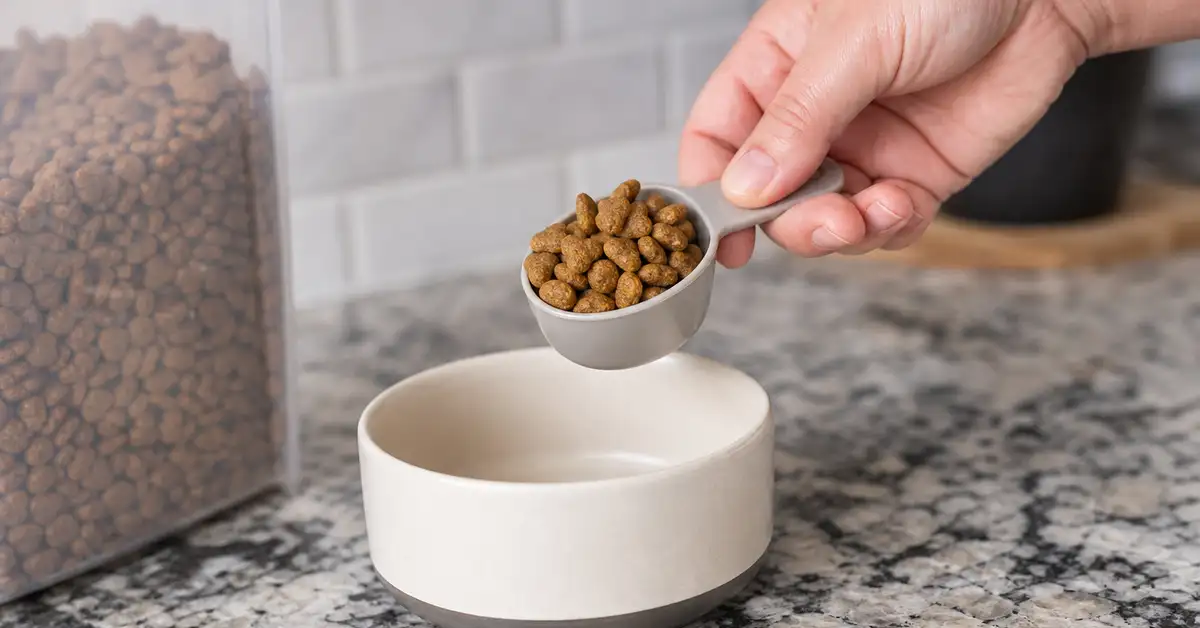
The table below assumes a representative dry food at 380 kcal per cup (about 3.8 kcal per gram) — a mid-range figure for indoor-cat kibble. Your own bag’s label may state anywhere from under 300 to over 450 kcal per cup, so treat these numbers as a starting point to be adjusted, not a fixed prescription.
| Cat’s weight (lb) | Typical daily calories (lean, neutered adult) | Dry food at 380 kcal/cup (cups/day) | Dry food at 380 kcal/cup (grams/day) |
|---|---|---|---|
| 8 lb | 230–240 kcal | 0.6–0.65 cups | 60–65 g |
| 10 lb | 270–280 kcal | 0.7–0.75 cups | 70–75 g |
| 12 lb | 300–315 kcal | 0.8–0.85 cups | 80–85 g |
| 15 lb | 355–365 kcal | 0.9–1.0 cups | 90–95 g |
Illustrative figures assuming 380 kcal/cup dry food, for lean neutered adult cats at a healthy body condition. Always check your specific product’s label and adjust with your vet (Rand et al., PMC, peer-reviewed; Cornell Feline Health Center).
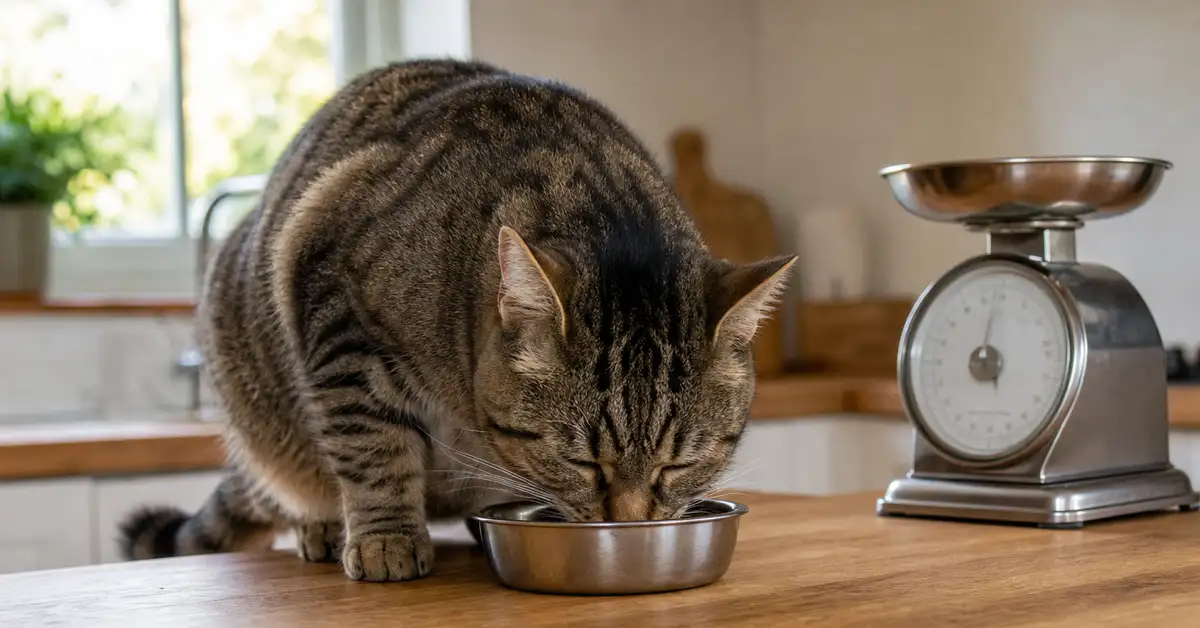
Veterinary educators increasingly recommend weighing kibble rather than scooping it — a “cup” measured by eye can vary by several kibbles either way, which adds up over months. If you’re actively managing weight, a simple kitchen scale is a more reliable tool than the scoop that came with the bag.
Feeding Amounts by Weight: Wet Food (Cans per Day)
Wet food is more energy-dilute than dry, and can size varies enough between brands that a “can” is an even less reliable unit than a “cup.” The table below illustrates two common can sizes using representative calorie values — 80 kcal for a standard 3-oz can and 180 kcal for a 5.5-oz can — again, figures to replace with your own product’s label.
| Cat’s weight (lb) | Typical daily calories | 3-oz cans/day (~80 kcal/can) | 5.5-oz cans/day (~180 kcal/can) |
|---|---|---|---|
| 8 lb | 230–240 kcal | ~3.0 cans | ~1.25–1.3 cans |
| 10 lb | 270–280 kcal | ~3.5 cans | ~1.5–1.6 cans |
| 12 lb | 300–315 kcal | ~4.0 cans | ~1.7–1.8 cans |
| 15 lb | 355–365 kcal | ~4.5–5.0 cans | ~2.0 cans |
Illustrative figures only — actual kcal per can varies by brand and formula. Check your product’s label and confirm portions with your vet (Rand et al., PMC, peer-reviewed; ASPCA).
If you feed a mix of wet and dry, the ASPCA and Cornell both stress that the two need to add up to one calorie total, not stack on top of each other at full portions each — for example, a cat with a 280-kcal target might get half that from dry and half from wet, at roughly half the dry-only and wet-only amounts shown in the tables above, not the full amount of both.
How Often to Feed: Kittens, Adults & Seniors
Meal frequency changes by life stage more than almost anything else. Cornell’s Feline Health Center gives a clear age-based structure: kittens up to six months generally do best on three meals a day; from six months to a year, twice-daily feeding is typically enough; and adult cats from about a year onward can be fed once or twice a day depending on the household’s routine and the cat’s health (Cornell Feline Health Center).
Senior cats (roughly 10 years and up) generally continue on the same once- or twice-daily pattern unless a vet recommends otherwise for a specific health reason. Twice-daily feeding is a reasonable default for most healthy adults, though cats in multi-cat homes or with certain behavioral needs sometimes do better on three or more smaller meals, which can better match a cat’s natural pattern of several small hunts through the day rather than one or two large meals (Cornell Feline Health Center).
Veterinary sources generally discourage leaving dry food out all day for free-choice grazing in most neutered indoor cats, since unrestricted access to an energy-dense food is a well-documented risk factor for weight gain (AAHA, 2021 Nutrition and Weight Management Guidelines). Wet food adds its own practical limit here too: an open can or bowl of wet food shouldn’t sit out more than a few hours, which naturally pushes households toward measured mealtimes rather than grazing.
Special Cases: Overweight, Post-Spay/Neuter & Senior Cats
The charts above are starting points for healthy, lean, neutered adult cats at a normal body condition — they are not appropriate as-is for a cat that’s already overweight, freshly spayed or neutered, or elderly with health changes. These situations call for an individualized plan, not a generic chart.
Overweight cats: weight-loss feeding is typically calculated from a cat’s ideal weight, not its current weight, and needs to be paired with regular body-condition monitoring under veterinary supervision — rapid or overly aggressive calorie restriction carries real risks in cats, so this is squarely a “talk to your vet first” situation, not a do-it-yourself diet plan (AAHA, 2021 Nutrition and Weight Management Guidelines).
Post-spay/neuter cats: a peer-reviewed review of feline obesity risk found that neutered cats allowed to eat freely gained substantially more weight than intact cats over the following months — driven mainly by eating more, not by a change in metabolism — and that many cats needed a meaningful reduction from free-choice intake (in some cases as much as 30-50% less) to hold a stable weight after surgery (Rand et al., PMC, peer-reviewed). In practice, this usually means switching a freshly neutered cat from free feeding to measured meals and checking in with your vet about the right target.
Senior cats: most seniors continue on the same meal frequency as younger adults, but if your cat has a health condition, ask your vet what and how much to feed. Any unexplained change in a senior cat’s weight, appetite, or eating behavior is worth a vet visit rather than a chart adjustment.
None of the figures above are a substitute for your vet’s individualized recommendation, especially in these three situations.
Where Automatic Feeders Fit In
Once you have a calorie target and a meal-frequency plan, the remaining challenge is often just consistency — delivering the same portion at the same time, every day, without relying on remembering to do it manually. This is where automatic feeders come in, as a tool for implementing a plan you’ve already worked out, not a replacement for working one out.
Automatic dry-food feeders store a measured supply of kibble and dispense a set amount on a schedule, which makes it easier to stick to the gram or cup figures in the chart above rather than eyeballing a scoop differently each time — see our full roundup of automatic cat feeders for verified picks across portion-control, multi-cat RFID, and camera-monitored options.
Wet food needs a different mechanical approach because it spoils faster than dry kibble at room temperature — feeders built for wet food typically use sealed, cooled compartments to keep pre-portioned meals safe until they’re dispensed. If you’re feeding wet food and want the same scheduling consistency, see our automatic wet and canned food feeder guide for verified options built specifically for that job.
Either type of feeder only helps if the portions loaded into it match a calorie target you’ve actually calculated — a feeder set to dispense generous, uncalculated portions on a schedule can maintain over-feeding just as easily as an unmeasured bowl.
Frequently Asked Questions
Methodology & Sources
This guide is research-led, not based on hands-on veterinary practice. Michael Probert, our author, is a longtime multi-cat owner writing from research and lived experience, not clinical or veterinary expertise — see our About page. We have no in-house veterinary reviewer; all feeding figures here are general, illustrative starting points sourced from the citations below and are not a substitute for professional veterinary advice or your own product’s feeding label.
Sources: Cornell Feline Health Center, How Often Should You Feed Your Cat?, Cornell Feline Health Center, Feeding, 2021 AAHA Nutrition and Weight Management Guidelines for Dogs and Cats, ASPCA, General Cat Care, and Rand et al., Risk of Obesity in the Neutered Cat, PMC (peer-reviewed).
See our best automatic cat feeders and best automatic wet food cat feeders guides for verified devices that help implement the portions above, or our full cat gear guide for everything else a cat owner needs.