Updated for 2026. An automatic cat feeder solves two very different problems depending on your household: reliable portion control for a cat that overeats when food is always available, and fair, undisturbed feeding when more than one cat shares a home. Below, we cover 9 verified dry-food automatic feeders across the segments that actually matter — timer-based portion control, RFID/microchip multi-cat gating, camera and app monitoring, and straightforward budget options with no app at all.
We lead with the specialist buying decisions — how RFID gating actually stops one cat stealing another’s food, what capacity and refill cadence really mean in practice, and where app/camera features are genuinely useful versus a subscription-gated nice-to-have — rather than a generic spec-dump. Wet and canned food have their own mechanical requirements (cooling, sealing, rotating trays) that a dry-food hopper doesn’t address; we cover that as its own guide separately, and this page focuses on dry kibble. If you’re building out a full gear list, see our cat gear guide.
How We Chose
Every feeder below was checked against its manufacturer or major-retailer listing page (Amazon, Chewy, the brand’s own site) for current availability, capacity, and stated features before inclusion. We cross-referenced specs across independent listings where possible, and we ran a safety check against the U.S. Consumer Product Safety Commission’s recall database — no recalls were found for any brand or product covered here as of this update. Capacity, portion sizes, and meal-count limits are stated in each manufacturer’s own terms; where a spec wasn’t published, we’ve said so rather than estimating it. Full policy: How We Choose.
Why Portion Control Actually Matters
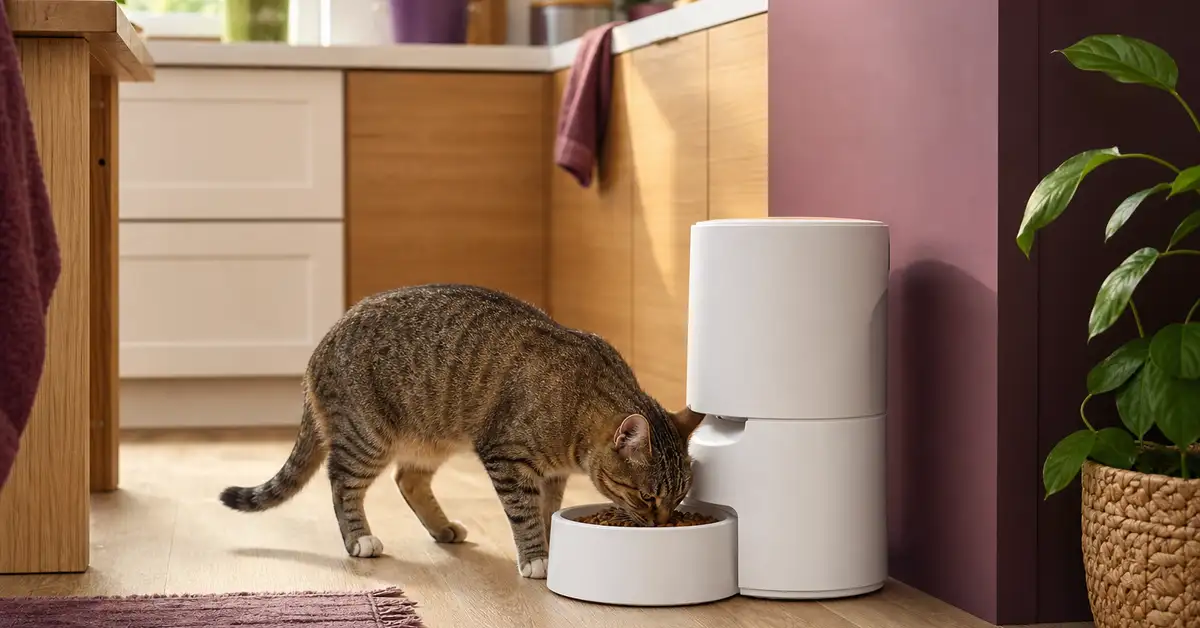
The single biggest reason people buy an automatic feeder isn’t convenience — it’s weight management. Free feeding, where dry food sits out all day for a cat to eat whenever it wants, is a major contributor to feline obesity: the Cornell Feline Health Center notes that free feeding dry food can lead some cats to overeat and gain inappropriate weight, and recommends feeding adult cats scheduled meals once or twice a day instead of leaving food out continuously. VCA Animal Hospitals puts a number on the scale of the problem: roughly 30 to 35% of the general cat population is classed as obese, and VCA’s guidance on weight loss is specific that portion control — a measured amount at a measured time, not just less food left out longer — is what actually works, along with the caution that simply shrinking a cat’s usual food volume can create nutrient gaps if it isn’t done under veterinary guidance.
An automatic feeder doesn’t replace that conversation with your vet, but it does make the mechanical part — delivering the same measured portion at the same time, every day, whether or not you’re home — consistent in a way manual feeding often isn’t. This is general information, not veterinary advice; if your cat is overweight or you’re planning a weight-loss diet, talk to your vet about the right target portion before you program any feeder.
RFID and Multi-Cat Feeding: What It Actually Solves
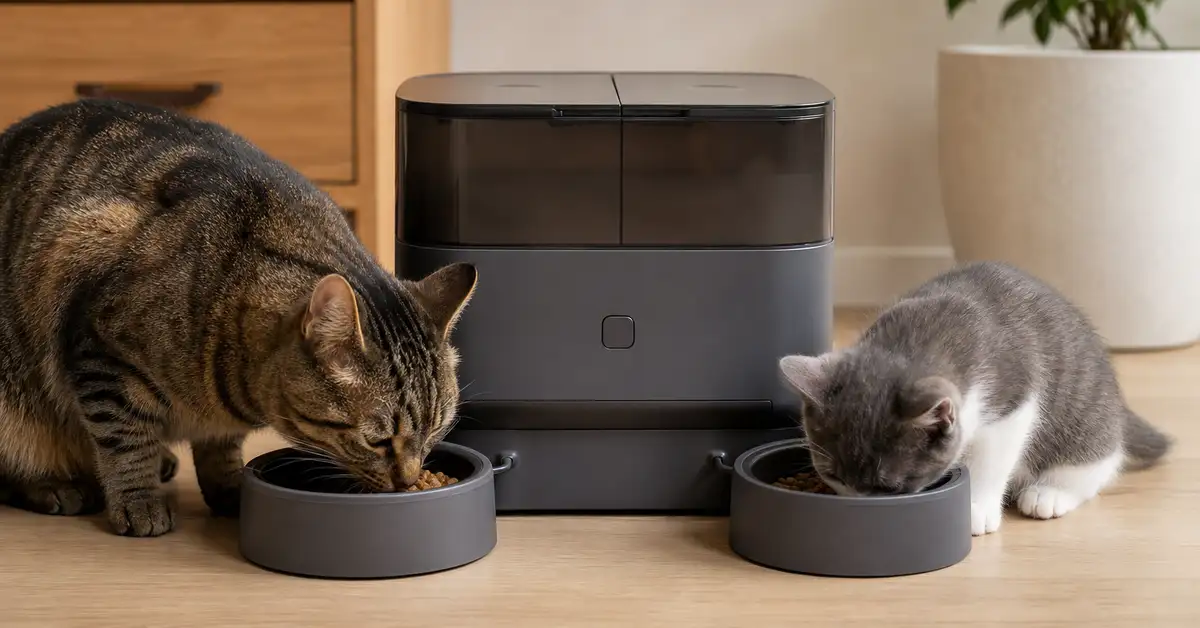
A plain timed hopper solves scheduling, but it doesn’t solve who eats it. In any multi-cat home, a faster or more food-motivated cat will happily finish a slower cat’s portion the moment it’s dispensed — which quietly undoes whatever portion control you set up in the first place, and can leave one cat consistently underfed while another gains weight. RFID or microchip-gated feeders (the mechanism behind SureFeed’s Microchip Pet Feeder Connect, for example) solve this directly: the feeder’s lid only opens for the specific cat wearing the registered collar tag or carrying the matching microchip, so a portion genuinely reaches the cat it was measured for. A plain app-scheduled hopper without gating — even a good one — doesn’t have any way to stop this; it’s a different feature solving a different problem, and it’s worth being clear-eyed about which one your household actually needs before paying a premium for either.
Camera and App Features: Genuinely Useful vs. Nice-to-Have
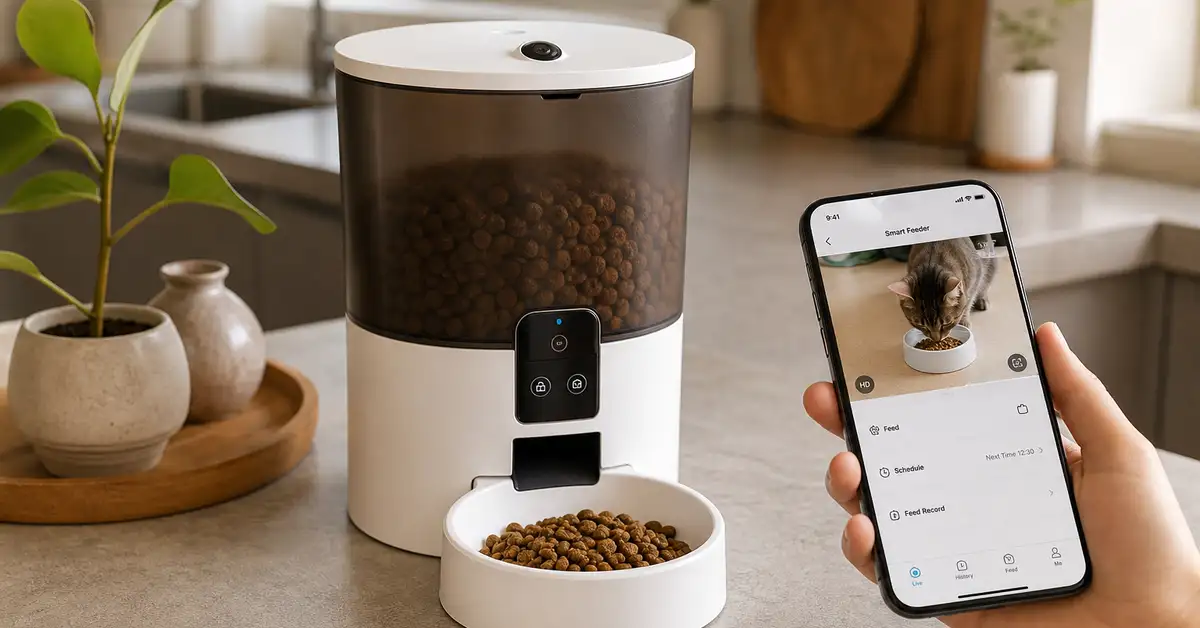
App control that lets you adjust a schedule remotely, or feed on demand when you’re stuck at the office, is a genuine convenience with no real downside beyond needing a stable Wi-Fi connection at the feeder’s location. A built-in camera is a bigger step up in both usefulness and complexity: it lets you actually watch your cat eat, which matters if you’re trying to confirm a shy cat in a multi-cat home is getting to the bowl at all, or if you simply want the reassurance while traveling. The honest caveat is that camera feeders depend entirely on your home Wi-Fi holding up, and several models on the market gate features like extended video history or two-way audio behind an optional subscription — check the manufacturer’s own product page for what’s included versus what needs a plan before assuming a camera model does everything out of the box.
Capacity, Refill Cadence, and Cleaning
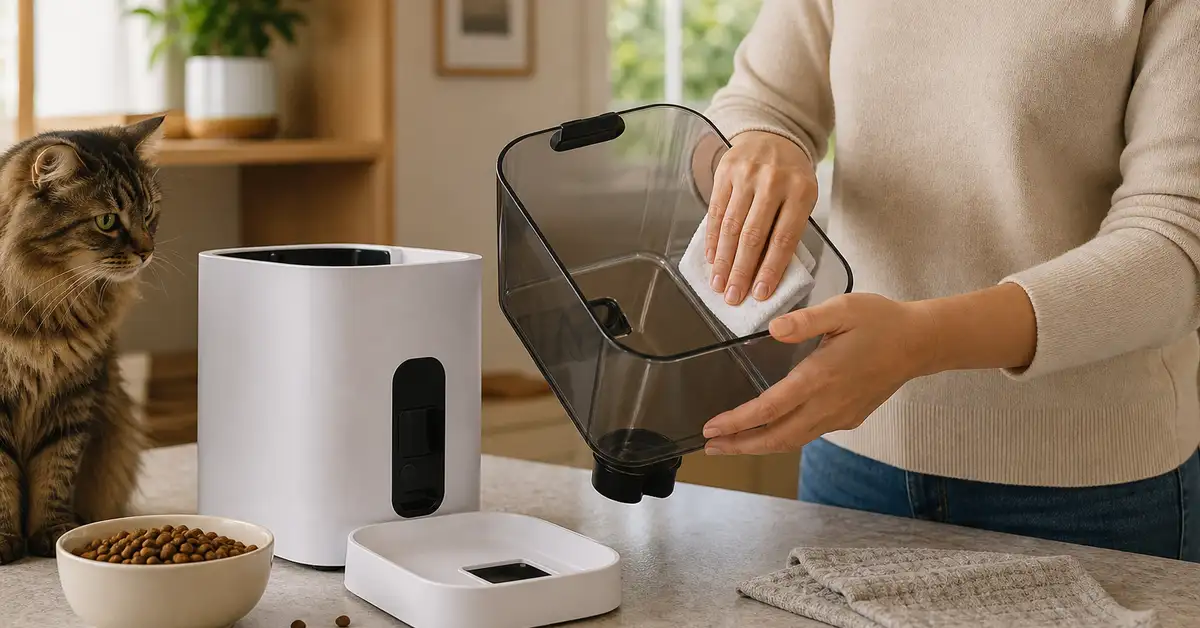
Manufacturers state capacity in cups or liters, and how far that actually stretches depends entirely on your cat’s daily food volume and how many cats share the feeder — a 5L hopper feeding one cat lasts far longer than the same hopper split between two. We’ve stated each feeder’s capacity in the manufacturer’s own terms below rather than translating it into a universal “days between refills” number, since that number changes household to household. One maintenance point that’s easy to overlook: even a fully automatic dry-food hopper still needs its bowl and hopper interior cleaned regularly. Dry kibble leaves oily residue and dust over time, and a feeder that’s never cleaned can develop odor or attract pests regardless of how well its scheduling works. None of that is a defect in any feeder below — it’s a standing part of owning one.
Transparency first: This guide contains affiliate links. If we’re enrolled in an affiliate program, we may earn a commission at no extra cost to you — it never affects how we research or rank. Read our full affiliate disclosure policy.
1. PETLIBRO Granary Automatic Pet Feeder with Camera — Best Overall
What it is: A 5L-capacity WiFi hopper feeder with a built-in 1080p camera, two-way audio, and app-based scheduling for up to 10 meals a day.
Best for: Cat parents who want one feeder that genuinely covers portion control, remote scheduling, and the reassurance of seeing your cat at feeding time, without stepping up to RFID gating.
Pros: 145° wide-angle 1080p camera with night vision covers the feeding area well; app supports up to 10 scheduled meals with adjustable portion sizes and multi-user family sharing; accepts a wide range of dry kibble sizes (2–15mm).
Cons: No RFID gating, so it doesn’t stop a second cat from finishing a portion meant for another; camera and two-way audio depend on a stable home WiFi connection.
Price band: $$$ (premium)
Evidence: Manufacturer listing, PETLIBRO.
2. SureFeed Microchip Pet Feeder Connect — Best for Multi-Cat Households (RFID)
What it is: An RFID/microchip-gated feeder whose lid only opens for a specific registered cat’s implanted microchip or a supplied collar tag, with app connectivity via a separate hub.
Best for: Multi-cat homes where one cat currently eats another’s portion — this is the one feature category on this list that a plain timed hopper cannot replicate.
Pros: Opens only for the registered pet, genuinely solving food-stealing between cats; integrated scale gives feedback accurate to within about 1g; works with either a full bowl or two half-bowls for wet and dry food side by side; 4x C batteries rated for 6+ months.
Cons: App/remote monitoring requires the separate Sure Petcare hub, sold apart from the feeder; at 400ml bowl capacity it’s sized for portioned meals, not multi-day unattended capacity; higher up-front cost than a plain hopper.
Price band: $$$ (premium)
Evidence: Manufacturer listing, Sure Petcare.
3. WOPET Automatic Cat Feeder with Camera for Two Cats — Best Camera Feeder for Two Cats
What it is: A 6L dual-bowl hopper feeder built for two cats, with a 1080p HD camera, night vision, 4x digital zoom, and two-way audio, controlling via 5G/2.4G WiFi.
Best for: Two-cat households that want camera monitoring on both bowls from a single unit, without the cost of two separate camera feeders.
Pros: Dual-bowl design lets each cat have its own scheduled portion from one feeder; 1080p camera with 4x digital zoom and night vision; supports up to 10 meals a day with 1–20 portions per meal; battery backup keeps feeding on schedule through a power outage.
Cons: Two bowls on one base means it still doesn’t stop a bolder cat from crossing over to the other bowl once food is dispensed — no RFID gating; video storage needs a micro SD card, sold separately.
Price band: $$$ (premium)
Evidence: Manufacturer/retailer listing, Amazon.
4. Cat Mate C500 Digital 5 Meal Automatic Feeder — Best Portion Control Without an App
What it is: A five-compartment mechanical-timer feeder (one immediate meal plus four scheduled ones) with a built-in ice-pack tray and no WiFi or app required.
Best for: Owners who want reliable scheduled portions without setting up an app or network connection, and who want wet or fresh food to stay cooler between meals.
Pros: Genuinely simple LCD-timer setup with no WiFi dependency to troubleshoot; each of the five compartments holds 11.5oz (330g), and the included ice packs help keep wet or fresh food safer between scheduled openings; tamper-resistant lid design; runs up to 12 months on 3 AA batteries.
Cons: Five compartments is a hard ceiling — no reordering or adding meals beyond that without refilling; no remote monitoring or camera; best suited to single-cat use given the fixed compartment portions.
Price band: $ (budget)
Evidence: Manufacturer/retailer listing, Chewy.
5. PetSafe Smart Feed 2.0 — Best Large Capacity
What it is: A 24-cup hopper feeder with a 5-cup stainless-steel bowl, WiFi app control, and a conveyor mechanism designed to resist food jams.
Best for: Households that want to go longer between refills without stepping up to a premium camera model, and that want a bowl that can be removed and washed easily.
Pros: 24-cup hopper capacity is among the largest of any feeder here, genuinely reducing refill frequency; stainless-steel bowl is dishwasher-safe; schedules up to 12 meals daily from 1/8 cup to 4 cups per meal; low-food and empty-hopper alerts push to your phone.
Cons: No camera or RFID gating; large 20.3″ x 9.4″ x 12.6″ footprint needs real counter or floor space; app dependency means a WiFi outage can delay remote schedule changes (the feeder still runs its last-saved schedule offline).
Price band: $$ (mid-range)
Evidence: Manufacturer/retailer listing, Chewy.
6. PETLIBRO Granary WiFi Automatic Pet Feeder (No Camera) — Best Budget App-Controlled Feeder
What it is: The non-camera version of PETLIBRO’s Granary line: a 5L hopper with 5G/2.4G WiFi app control, up to 10 meals a day, and a low-food sensor.
Best for: Anyone who wants genuine app scheduling and remote feeding without paying the premium a built-in camera adds.
Pros: Same 5L capacity and app scheduling flexibility (up to 10 meals, 1–48 portions per meal) as the camera version at a meaningfully lower cost; runs on a DC power adapter or 3 D batteries as backup; low-food blockage sensor flags issues before the hopper runs dry.
Cons: No visual confirmation of whether food actually reached the bowl without a camera; no RFID gating for multi-cat households.
Price band: $$ (mid-range)
Evidence: Manufacturer listing, PETLIBRO.
7. oneisall 5G WiFi Automatic Cat Feeder for 2 Cats — Best Dual-Bowl Feeder for Two Cats
What it is: A 5L/20-cup dual stainless-steel-bowl feeder built specifically for two cats, with app scheduling, feeding logs, and a slow-feed setting.
Best for: Two-cat households on a mid-range budget that want separate, app-scheduled portions for each cat without a camera or RFID hardware.
Pros: Stainless-steel bowls are easy to clean and more hygienic long-term than plastic; app tracks feeding logs so you can confirm meals actually dispensed; slow-feed setting helps cats that eat too fast; a full 5L hopper is stated to feed 2 adult cats for about 10 days.
Cons: No RFID gating — a food-motivated cat can still cross to the other bowl; app and WiFi setup is a genuine step up in complexity from a mechanical timer feeder like the Cat Mate C500.
Price band: $$ (mid-range)
Evidence: Manufacturer/retailer listing, Amazon.
8. iPettie WiFi Automatic Pet Feeder for 2 Pets — Best for Flexible Meal Scheduling
What it is: A 5L WiFi feeder with two 1-cup bowls, supporting 1–10 meals a day and 1–12 portions per meal, with multi-account app sharing.
Best for: Households whose feeding routine changes day to day and want fine-grained control over both meal count and portion size rather than a fixed number of compartments.
Pros: Wide scheduling range (1–10 meals, 1–12 portions each) covers everything from a simple twice-daily routine to a more spread-out feeding plan; multi-account sharing lets more than one household member manage feeding; dual bowls suit two cats or a single cat that prefers rotating bowls.
Cons: No camera or RFID gating on this model; 5L capacity is mid-pack, not a large-capacity option for households wanting the longest possible stretch between refills.
Price band: $$ (mid-range)
Evidence: Manufacturer listing, iPettie.
9. Arf Pets Automatic Pet Feeder — Best Budget Overall
What it is: An 18-cup hopper feeder with a magnetic-lock lid, LCD timer, and programmable portions from 1 to 10 24ml servings, up to four meals a day — no app or WiFi involved.
Best for: Anyone who wants dependable scheduled portions at the lowest entry cost on this list, and doesn’t need remote monitoring.
Pros: Lowest price band here while still offering genuine portion-size control (24ml increments) and up to four programmable meals; magnetic-lock lid deters a determined cat from digging in early; runs on 3 D batteries or plugs in.
Cons: No app, camera, or remote monitoring of any kind; 18-cup capacity is smaller than the PetSafe Smart Feed 2.0, so multi-cat households will refill more often.
Price band: $ (budget)
Evidence: Manufacturer/retailer listing, Chewy.
Frequently Asked Questions
Methodology & Sources
This guide draws on manufacturer and major-retailer specifications (PETLIBRO, Sure Petcare, Chewy, Amazon, iPettie) checked for current availability before inclusion, and on feeding and weight-management guidance from the Cornell Feline Health Center and VCA Animal Hospitals. No CPSC recalls were found for any brand or product covered here as of this update; this is a point-in-time safety check, not a guarantee against future recalls. Michael Probert, our author, is a longtime multi-cat owner writing from research and lived experience, not clinical or veterinary expertise — see our About page. We have no in-house veterinary reviewer. Full editorial policy: How We Choose.
Sources: Cornell Feline Health Center, Obesity, Cornell Feline Health Center, How Often Should You Feed Your Cat?, VCA Animal Hospitals, Obesity in Cats, and manufacturer/retailer listings linked throughout.
See our full cat gear guide for everything else a new cat parent needs. A dedicated guide to automatic wet-food feeders — covering cooling, sealing, and rotating-tray mechanisms this dry-food roundup doesn’t — is in progress.