Updated for 2026. A gravity feeder is the simplest possible way to keep a cat’s bowl from running empty: a hopper of dry food sits above a tray, and gravity tops the tray up as the cat eats. That simplicity is genuinely useful, but it also means a gravity feeder can’t do the one thing many households actually need — control how much food a cat eats and when. This is an honest look at what gravity feeders do well, where they fall short, and how to decide whether one is right for your cat, or whether a timed automatic feeder is the better fit.
This is general information for cat owners, not veterinary advice. We are not veterinarians and have no in-house vet reviewer — if you’re managing a cat’s weight, a medical condition, or a multi-cat feeding conflict, talk to your vet before choosing a feeding setup.
How We Researched This
This guide draws on the Association for Pet Obesity Prevention’s 2022 State of Pet Obesity report, a peer-reviewed review of obesity risk in neutered cats published on PubMed Central (National Institutes of Health), and general client-facing guidance from the American Animal Hospital Association (AAHA) and the American Veterinary Medical Association (AVMA), plus behavioral framing from Feline Behavior Solutions. Several claims below — food staling, pest attraction, multi-cat fairness — are grounded in general food-science, pest-management, and behavioral principles rather than trials that tested gravity feeders specifically as a device category; where that’s the case, we say so plainly rather than imply a study measured something it didn’t. Full policy: How We Choose.
How Gravity Feeders Work
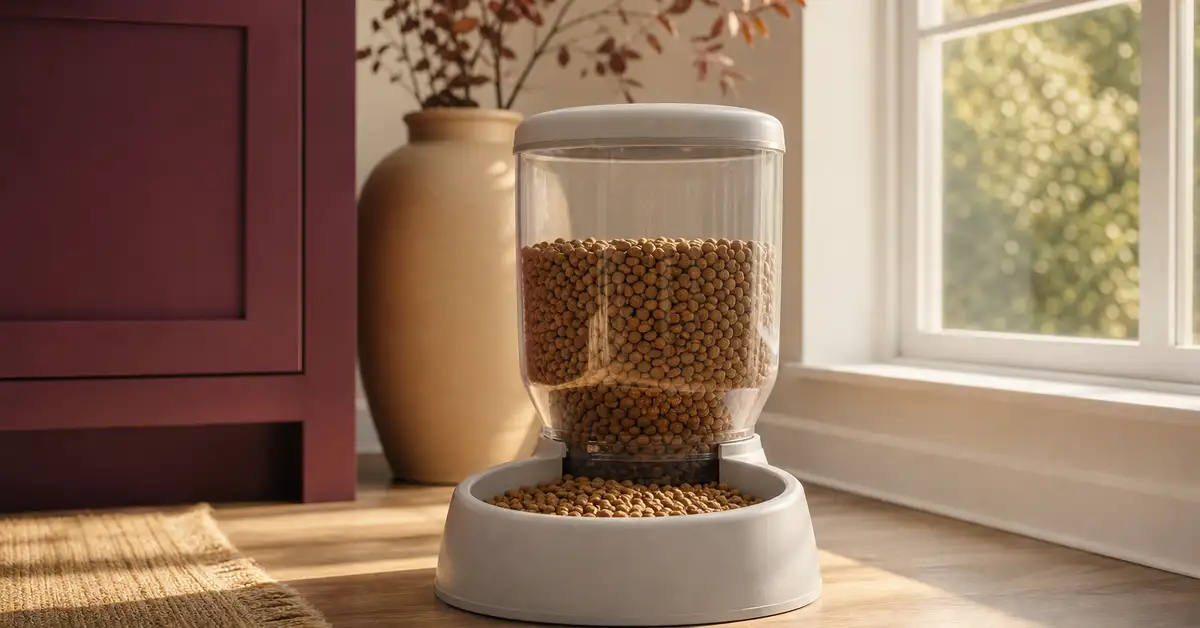
A gravity feeder is a hopper-and-tray design: an upright container holds a reserve of dry kibble above a shallow bowl, with an outlet sized so that food flows down only until it reaches the outlet’s own height in the tray. As the cat eats and the tray level drops below that point, gravity pulls more kibble down to refill it. There’s no clock, no motor, no app — the only “mechanism” is the container’s own geometry.
That’s the key difference from a timed automatic feeder, which uses a motorized carousel, auger, or latch-released compartment to dispense a measured portion at a scheduled time. A gravity feeder doesn’t know what time it is and doesn’t limit how much a cat eats in one sitting — it just keeps the bowl topped up. Both get marketed as “automatic,” but a gravity feeder automates availability, while a timed feeder automates portion and timing. That distinction matters more than it sounds, because most of the health and behavior concerns owners actually run into — overeating, one cat outcompeting another, food sitting out too long — come down to how much and how often, not whether a human had to physically pour the food.
Capacity is usually stated in cups or liters rather than days, because how long a hopper actually lasts depends entirely on the cat’s own daily intake. A rough illustrative example: a lean adult cat’s maintenance needs might run somewhere in the range of 40–70 kcal per pound of body weight per day depending on the food’s energy density and the cat’s activity level — always confirm your own product’s label and your cat’s target with your vet rather than assume a number. On that basis, a modest 1 kg hopper could theoretically stretch across a couple of weeks for one cat if nothing else changed, but “theoretically lasts two weeks” is not the same as “safe to leave unattended for two weeks” — cats need daily monitoring regardless of how full the bowl is.
Genuine Advantages
Where gravity feeders earn their keep is in pure mechanical simplicity. There’s nothing to program, no batteries to die mid-week, no firmware to update, and no risk that a power outage leaves the bowl empty — if the hopper has food and the outlet isn’t blocked, it works. That reliability, plus a typically lower price than an electronic timed feeder, makes gravity feeders an accessible entry point for households that don’t need portion control and just want a backup against a delayed commute or an unpredictable schedule.
They’re also quiet. Timed feeders can whir, click, or snap open at a scheduled moment, which occasionally startles a noise-sensitive cat; a gravity feeder makes little more than the soft rattle of kibble sliding down as the cat eats. For a single, lean, healthy cat with a stable routine and no history of overeating, a gravity feeder used as a measured reserve — filled with a set daily ration rather than topped to the brim — can be a reasonable, low-maintenance choice.
Genuine Drawbacks (Sourced)
Free-feeding and weight gain. The most significant drawback is that a gravity feeder is, by design, a way of implementing free-choice (ad libitum) feeding of dry food. The Association for Pet Obesity Prevention’s 2022 survey found 61% of cats evaluated by US veterinary professionals were classified as overweight or having obesity, and specifically flagged free-choice feeding and inconsistent portion measurement as contributors. A peer-reviewed review of obesity risk in neutered cats (PMC, National Institutes of Health) goes further: ad libitum feeding after neutering is repeatedly associated with greater body weight and body fat, and some cats needed a substantial reduction from free-choice intake — in some cases as much as 30–50% less — to hold a stable weight afterward. To be precise about what the evidence actually shows: no study we found tested gravity feeders as a device category against obesity outcomes directly. What the research does show clearly is that free-choice access to dry food is a documented risk factor, especially in neutered and indoor cats, and a gravity feeder’s entire function is to make free-choice access easier to maintain.
Staling and pest attraction. Dry food left exposed to air and warmth for extended periods can oxidize and lose palatability faster than food refreshed daily, and a large hopper filled infrequently sits exposed longer than a bowl refilled each day. In warm or humid homes, or ground-floor apartments, exposed kibble can also attract ants or, less often, rodents. We didn’t find feeder-specific trials measuring either effect; both concerns rest on general food-science and pest-management principles rather than device-specific data, which is worth knowing before treating either as a settled fact.
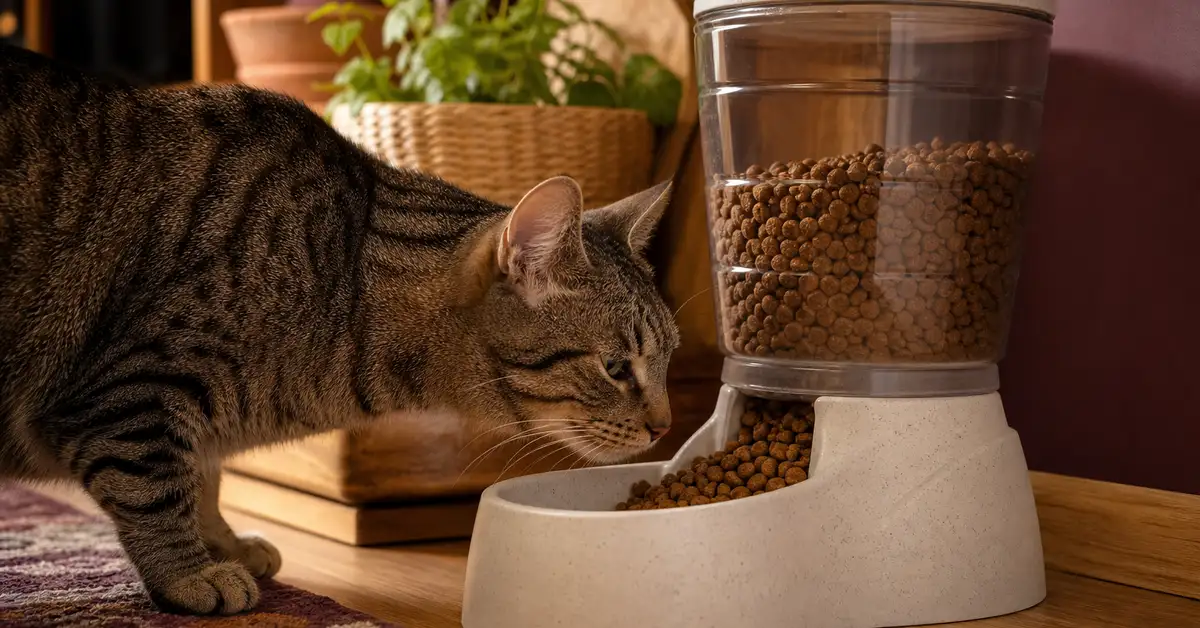
Multi-cat fairness. A gravity feeder can’t tell which cat is eating, so it can’t enforce turn-taking. In multi-cat homes, a more confident or food-motivated cat can position itself at the feeder and consume a disproportionate share, while a more timid cat eats less — even though, from the guardian’s perspective, “there’s always food available.” This is a behavioral pattern documented by feline behaviorists in the context of resource competition generally, rather than a controlled trial specifically comparing gravity feeders to other setups.
Wet food and meal spacing. Gravity feeders are dry-food only — wet or fresh food spoils too fast at room temperature to sit in an open tray. They also can’t slow down a fast eater or space meals into smaller portions the way a timed feeder can, which matters for cats prone to regurgitating after large meals or on a vet-prescribed feeding schedule.
Hygiene. Because the hopper holds food for extended periods, the whole unit — not just the tray — needs regular washing and thorough drying to avoid moisture buildup, something that’s easy to defer precisely because the feeder’s convenience reduces how often a guardian has to interact with it.
When to Upgrade to an Automatic Feeder
A useful way to frame the decision: gravity feeders solve the human problem of irregular availability, while timed automatic feeders solve the cat-centric problem of structured, measured intake. If your only goal is making sure the bowl isn’t empty when you’re running late, a gravity feeder can do that. If your vet has recommended a specific calorie target or meal schedule — common after neutering, with an overweight cat, or for a cat on a prescription diet — a timed feeder that dispenses measured portions is built for that job in a way a gravity feeder simply isn’t.
The same logic applies to multi-cat households where one cat is outcompeting another, or to a cat that regurgitates after eating too much at once: these are structural problems that a gravity feeder’s design can’t address, no matter how it’s used. For a side-by-side look at dry-food timed feeders, including RFID-gated options that solve the multi-cat fairness problem directly, see our best automatic cat feeders guide. If wet or canned food is part of the picture, see our best automatic wet food cat feeders guide — a different mechanical problem entirely, since wet food needs cooling and sealing that a gravity hopper can’t provide.
Upgrading doesn’t have to be all-or-nothing. Some households use a small gravity feeder as a low-calorie backup alongside a timed feeder handling the bulk of daily calories — as long as the total from both is tracked against one calorie budget, not treated as two separate full portions.
Frequently Asked Questions
Methodology & Sources
This guide is research-led, not based on hands-on veterinary practice or product testing. Michael Probert, our author, is a longtime multi-cat owner writing from research and lived experience, not clinical or veterinary expertise — see our About page. We have no in-house veterinary reviewer; all health-adjacent framing here is general information sourced from the citations below, not a substitute for professional veterinary advice.
Sources: Association for Pet Obesity Prevention, 2022 U.S. State of Pet Obesity Report, Risk of Obesity in the Neutered Cat, PMC — National Institutes of Health (peer-reviewed), AAHA, For Pet Parents, AVMA, Caring for Senior Cats and Dogs, and Feline Behavior Solutions, Hiding Behavior in Cats (behavioral/resource-competition framing, used as a supporting source).
See our best automatic cat feeders and best automatic wet food cat feeders guides for timed, portion-controlled alternatives, or our full cat gear guide for everything else a cat owner needs.