Updated for 2026. Most “best cat tree” lists are photographed and written for function first — carpet, capacity, weight ratings — and looks are an afterthought. This guide is for the opposite buyer: someone who will not put a beige carpeted tower in a styled living room, and wants a piece that reads as furniture first and cat gear second. We cover eight verified picks across the formats that actually deliver on that brief — solid wood, boucle/velvet upholstery, wall-mounted shelf systems, and low-profile side-table styles — evaluated on materials, finish, and how each one integrates with a room, not on weight capacity or multi-cat headcount. If capacity for a large-breed cat or a multi-cat household is your primary need, see our best cat trees for large cats guide or our best cat trees for multiple cats guide instead — none of the eight picks below repeat products from either list, and every product here is evaluated on a different axis (design and materials) than either sibling guide uses.
How We Chose
Every product below had a live listing from the manufacturer directly or from a named major retailer as of October 2026 — Chewy or the manufacturer’s own site — and we checked each one against that listing for current availability, stated materials, and dimensions before including it. We screened every product against CPSC recall records; none turned up a recall for any brand covered here. This is a genuinely low-volume niche within a niche, and we would rather ship a shorter, honest list than pad it: we started with 11 candidates and dropped three. Mjau Home’s modular cube system, a strong design candidate, is currently unavailable — the company has paused production and sales while it reworks its manufacturing, so we’re naming it here rather than recommending a product you can’t buy. A second wall-shelf brand was dropped after its own website returned an unrelated, suspicious-looking promotional line injected alongside its normal product pages during our verification pass — we don’t link to a site we can’t vouch for, regardless of how the product itself looks. A third candidate (a European designer brand) was dropped because it doesn’t currently ship to US buyers in a way we could verify cleanly. What’s left is eight products we could fully verify: real current listings, stated materials from the manufacturer, and no recall history.
Materials That Actually Read as “Modern”
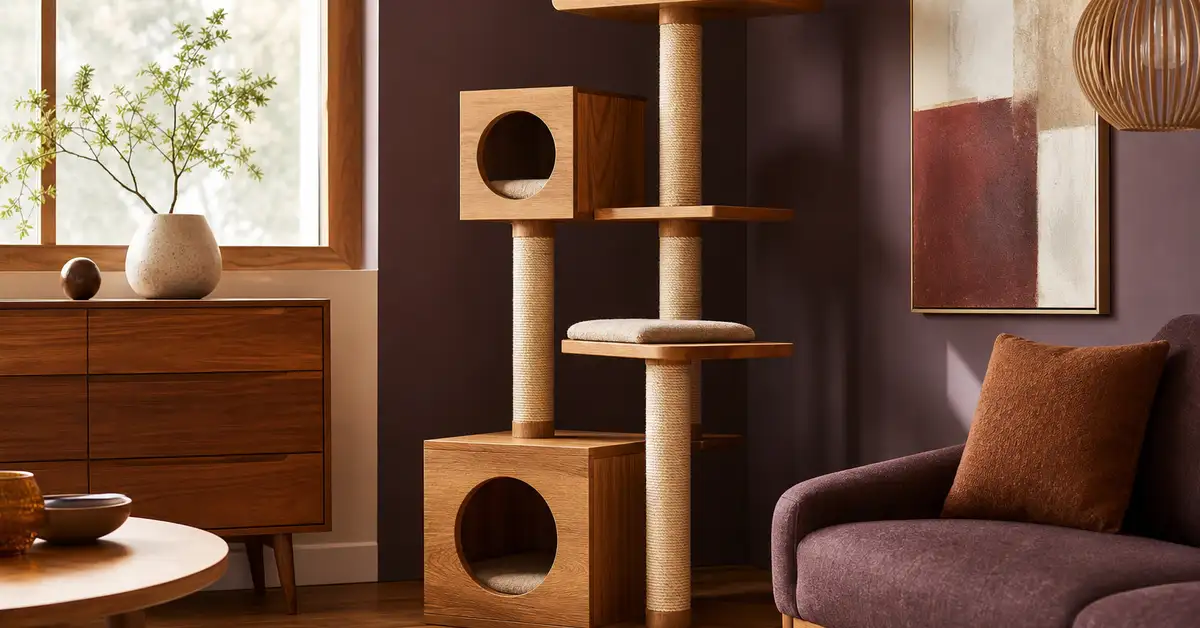
Four material categories cover almost everything in this space, and they read very differently in a room. Solid wood or real wood veneer over plywood (like an oak-veneer tower) looks and feels like actual furniture and tends to be the most expensive way to build a cat tree. MDF with a wood-look laminate finish is the mid-tier answer — it doesn’t attract cat hair the way carpet does, cleans easily, and reads as furniture from a normal viewing distance, though it’s not real wood. Boucle, velvet, and other upholstered fabrics are the newest entrant: a plush, tightly-woven fabric in a neutral tone that looks intentional rather than accidental, standing in for the shag-carpet aesthetic of a traditional tower. Natural jute or sisal left undyed shows up on scratching surfaces across almost every price point here — it’s less about the “modern” look specifically and more about a neutral, textural material that doesn’t clash with anything. We report what each manufacturer states its materials are, not our own guess from photos.
Footprint and How These Integrate With Real Furniture
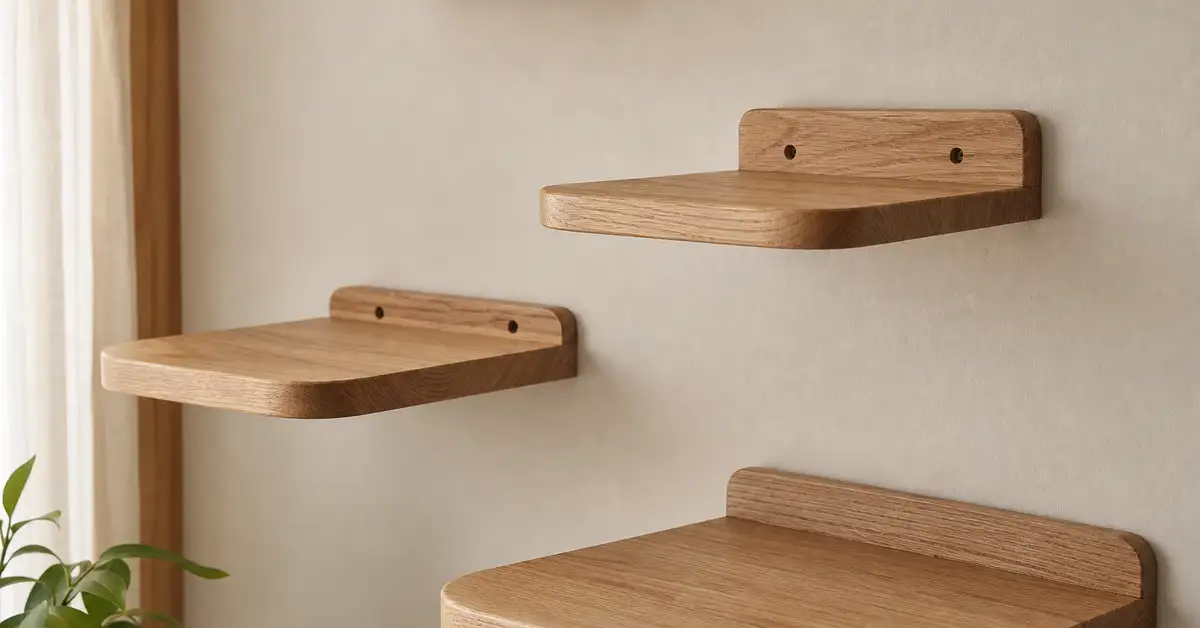
The traditional floor-standing tower isn’t the only format here, and for a design-conscious buyer, footprint often matters as much as material. Wall-mounted shelf systems are a genuinely distinct sub-format from a floor tower: they use zero floor space, can be arranged as a staggered climbing path rather than a single vertical structure, and read more like shelving than pet furniture — the tradeoff is a permanent wall installation into studs, and a lower weight tolerance per shelf than a floor-standing tower’s base. Low-profile, side-table-style pieces are built to double as an actual side table or plant stand at normal furniture height, trading vertical climbing space for a footprint that disappears into a room the way a floor-to-ceiling tower never will. Traditional floor towers still make sense when you want real climbing height, and a modern finish doesn’t change that math — it just changes what the structure looks like while doing it. None of these formats is objectively better; they solve different room-layout problems, and we’ve tried to cover more than one below rather than defaulting to floor towers across the board.
Transparency first: This guide contains affiliate links. If we’re enrolled in an affiliate program, we may earn a commission at no extra cost to you — it never affects how we research or rank. Read our full affiliate disclosure policy.
1. Frisco 62-in Modern Cat Tree & Condo, Gray — Best Overall Modern Cat Tree
What it is: A 62-inch tower from Chewy’s house brand built specifically as a “modern” line — engineered wood construction finished in a gray or natural wood-grain laminate, with a squared-off silhouette rather than a traditional carpeted trunk.
Best for: Buyers who want the clearest single upgrade from a traditional carpeted tower to a furniture-look silhouette, without moving into premium-tower pricing.
Materials & finish: Engineered wood core (manufacturer-stated), finished in a wood-grain laminate in gray or natural, with a removable eyelash faux-fur cushion. Six sisal-wrapped scratching posts and two sisal scratching mats provide the actual clawing surfaces.
Footprint & integration: Fully assembled 62″ H x 22″ W x 22″ D on a 22″ x 22″ baseboard — a compact square footprint that reads as a single furniture object rather than a sprawling structure. Two 13.4″ cube apartments and a top perch.
Pros: The clearest “modern” silhouette at this price point on Chewy; wood-grain laminate resists cat hair better than carpet and is easy to wipe down; two enclosed apartments plus a top perch cover most single- or two-cat needs.
Cons: Laminate over engineered wood, not real wood veneer — it looks the part but isn’t the furniture-grade material of our wood pick below; no published whole-tower weight rating.
Price band: $$ (mid-range)
Evidence: Manufacturer/retailer listing, Chewy.
2. The Refined Feline Lotus Cat Tower — Best Wood/Furniture-Grade
What it is: A 69-inch tower built from premium plywood with a real oak veneer, in a curved, symmetrical silhouette the manufacturer designed to look like sculptural furniture rather than a cat tower — sold direct from the manufacturer with over 1,300 published customer reviews.
Best for: Buyers who want genuine furniture-grade material, not a laminate imitation, and are willing to pay a premium price for it.
Materials & finish: Premium plywood with a real oak veneer (manufacturer-stated), available in five finishes (mahogany, smoke gray, dark espresso, ebony, and white), Berber carpet or plush faux-fur platform coverings, a natural sisal scratching pad, and non-toxic GREENGUARD Gold Certified paint.
Footprint & integration: 20″ W x 20″ D x 69″ H — a compact, symmetrical square footprint for its height, with a hidden cushioned cubby at the base rather than a bulky open condo box, which keeps the silhouette clean.
Pros: Real oak veneer, not laminate, is a genuine material step up from every other pick on this list; adjustable floor levelers and a reinforced support bar for stability; replaceable carpet, cushions, and sisal pad extend its usable life well past a typical carpeted tower.
Cons: The most expensive pick on this list by a wide margin; assembly takes about an hour and several reviewers note a slight wobble at the top platform until the support bar bolts are fully tightened — a stability note worth acting on, not just accepting.
Price band: $$$$ (splurge)
Evidence: Manufacturer listing, The Refined Feline.
3. CatastrophiCreations Wall-Mounted Cat Shelf — Best Solid-Wood Wall-Mounted System
What it is: A single 34-inch solid-wood shelf, handcrafted in the USA, designed to mount across three wall studs at 16 inches on center — sold directly by the manufacturer, who builds a full modular ecosystem of compatible shelves, bridges, and nests around this base unit.
Best for: Buyers who want a genuinely zero-floor-footprint wall system built from solid wood rather than a fabric-and-frame shelf, and who are comfortable mounting into studs.
Materials & finish: Solid wood (English Chestnut bamboo per the manufacturer’s current listing), with metal wall brackets — no MDF, laminate, or fabric involved in the shelf itself.
Footprint & integration: Zero floor footprint by design; a 34″ span mounted to the wall, and it’s part of a modular system so additional shelves, bridges, and ledges can be added later to build out a full climbing wall rather than committing to one fixed structure up front.
Pros: Real solid wood with genuine wood-grain variation, not a printed finish; manufacturer states each solid-wood shelf is weight-tested to hold 85 lb when mounted into a stud; expandable system means you’re not locked into today’s layout.
Cons: Requires mounting into wall studs for the full rated weight capacity — a drywall-anchor-only install is explicitly a lower-strength fallback per the manufacturer; a single shelf alone won’t give a cat much vertical climbing range, and building out a full wall system costs more than one shelf.
Price band: $ (budget per shelf; $$$ for a full multi-shelf wall system)
Evidence: Manufacturer listing, CatastrophiCreations.
4. Frisco Hexagon Wall Mounted Cat Wall Shelf — Best Modular Wall-Mounted Shelf System
What it is: A geometric, hexagon-shaped wall shelf from Chewy’s house brand, built as an enclosed hideout rather than an open plank, with a cushioned interior and a sisal-topped exterior — designed to mix and match with other shapes in the same line.
Best for: Buyers who want a wall system with a distinct geometric, gallery-wall aesthetic rather than a plain plank shelf, and who may want to combine multiple shapes over time.
Materials & finish: Manufacturer describes an engineered-wood shell with a removable, washable eyelash-fabric cushion inside and a sisal mat on top for scratching; comes with a cat teaser wand toy.
Footprint & integration: 19.6″ L x 12″ W x 17″ H per unit, wall-mounted with zero floor footprint; the modular design is explicitly built so multiple units combine into a larger geometric “crash pad” arrangement on one wall.
Pros: The enclosed hexagon shape gives a hiding spot, not just an open perch, which an open plank shelf doesn’t offer; genuinely modular — buy one now and add more shapes later without replacing anything; washable interior cushion.
Cons: Manufacturer states a recommended weight limit of up to 20 lb when properly installed — noticeably lower than a solid-wood stud-mounted shelf, so it suits an average-weight cat rather than a large breed; engineered wood and fabric rather than solid wood.
Price band: $ (budget per shelf)
Evidence: Manufacturer/retailer listing, Chewy.
5. MYZOO Spaceship Alpha — Best Low-Profile/Side-Table Style
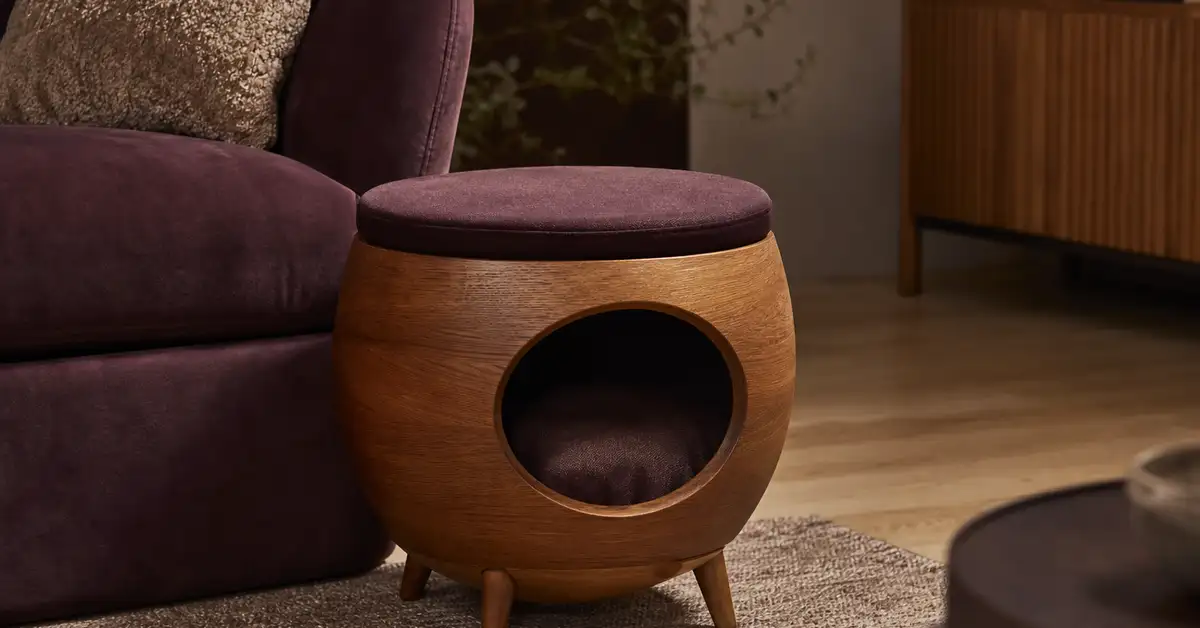
What it is: A rounded, capsule-shaped wood-and-acrylic pod bed designed to sit on the floor at side-table height, or on top of furniture — a sculptural piece as much as a cat bed, with a transparent acrylic dome that lets a cat see out while resting inside.
Best for: Small apartments or minimalist rooms where a tall tower doesn’t fit the aesthetic and a low, sculptural object reads better as a design piece.
Materials & finish: Plywood body with a wood veneer finish (walnut, light brown, or dark brown options) and a transparent acrylic dome window, per the manufacturer and matching retailer listings.
Footprint & integration: Approximately 25.6″ L x 16.5″ W x 16.5″ H — genuinely low-profile compared with every other pick on this list, closer to a side table or ottoman in scale than a cat tree.
Pros: The most genuinely sculptural, non-tree-shaped option here, which suits a buyer who specifically doesn’t want anything that reads as “cat furniture” at a glance; four air holes for ventilation and circulation per the manufacturer; low enough to tuck beside a sofa or under a window.
Cons: No scratching surface at all — this is a bed/perch, not a scratcher, so it needs pairing with a separate scratching post; manufacturer states a maximum load capacity of 33 lb, which caps it below some larger cats.
Price band: $$ (mid-range)
Evidence: Manufacturer listing, MYZOO.
6. Frisco 59-in Faux Fur Deluxe Cat Tree & Condo, Gray — Best Plush/Velvet-Style Upholstered
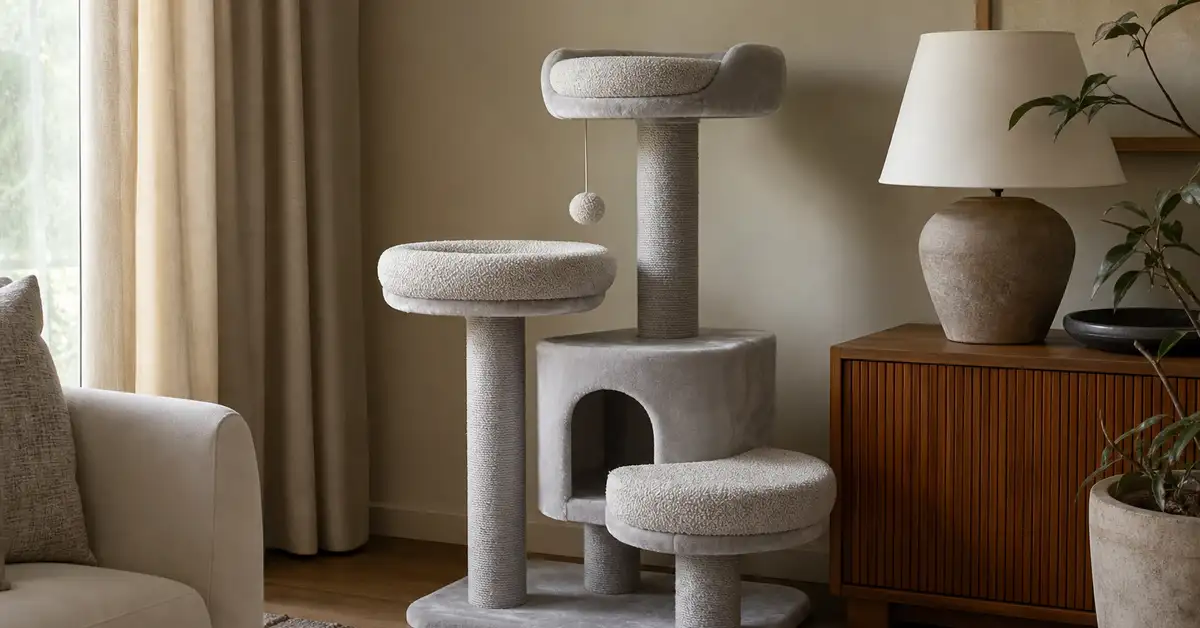
What it is: A 59-inch tower from Chewy’s house brand upholstered entirely in a plush fabric the manufacturer describes as having a “swanky, velvety look” — the closest match in this category to the boucle-and-velvet furniture trend, though the manufacturer names it as a plush faux-fur-style fabric rather than woven boucle specifically.
Best for: Buyers who specifically want the soft, upholstered-furniture look and are prioritizing that over a hard wood or laminate finish.
Materials & finish: Engineered wood core (manufacturer-confirmed, matching the rest of the Frisco tree line) fully covered in a plush fabric in a neutral gray, with sisal-wrapped scratching posts and a plush hammock.
Footprint & integration: Fully assembled 59″ H x 29.75″ W x 36″ L on an 18.89″ x 23.62″ baseboard, with one 15.74″ x 13.77″ x 11.02″ apartment and two top perches with removable, machine-washable bolstered covers.
Pros: The plush, all-over upholstered look genuinely differs from every laminate or wood pick above and suits a softer, more textural room; removable, washable perch covers make the upholstery practical rather than just decorative.
Cons: Plush fabric shows dirt and matting faster than sisal or solid wood, and the manufacturer doesn’t sell replacement fabric panels the way it does cushions on some other lines; no published whole-tower weight rating.
Price band: $ (budget)
Evidence: Manufacturer/retailer listing, Chewy.
7. Catit Vesper High Base 47.8-in — Best Sculptural MDF Multi-Level Design
What it is: A 47.8-inch, four-level tower built around an off-center, stacked-box silhouette the manufacturer designed to look like a piece of modern art rather than a traditional trunk-and-platform tree, with a fully enclosed cube den.
Best for: Buyers who want the most deliberately sculptural, gallery-piece silhouette on this list, in a material that resists cat hair better than fabric or carpet.
Materials & finish: High-quality MDF with a smooth laminate finish, available in walnut, oak, or black; memory-foam cushions inside the den and on the platforms; tall seagrass scratching posts and a sisal scratching mat.
Footprint & integration: 47.8″ H x 22.1″ W x 22.1″ D — a compact square footprint with an intentionally off-center, stacked-box silhouette rather than a symmetrical trunk shape, which is the most visually distinctive form factor on this list.
Pros: Smooth MDF laminate genuinely doesn’t collect cat hair the way carpet or plush fabric does, per the manufacturer; every cushion, mat, and post is sold as a separately replaceable part; the enclosed cube den has two entrances so a cat doesn’t feel cornered.
Cons: MDF is not solid wood and won’t have the grain variation of our wood pick above; no whole-tower weight rating is published by the manufacturer.
Price band: $$ (mid-range)
Evidence: Manufacturer/retailer listing, Chewy.
8. Frisco 41-in Modern Cat Tree & Condo, Gray — Best Budget Modern
What it is: A compact, 41-inch entry point into the same Chewy “modern” line as our Best Overall pick above, sharing the same wood-grain laminate finish and squared silhouette at a lower height and price.
Best for: Buyers who want the modern laminate look without committing to a 60-plus-inch structure, or who are testing whether a design-forward tree will actually get used before spending more.
Materials & finish: Engineered wood core (manufacturer-confirmed) finished in a wood-grain laminate, available in gray or natural, with sisal-wrapped scratching posts.
Footprint & integration: 41″ tall — the shortest tower on this list — sized to fit smaller rooms or corners where a 60-plus-inch tower would dominate the space.
Pros: The lowest price of any floor tower on this list while keeping the same modern laminate look as our top pick; small enough for a studio apartment or a home office corner; sisal posts provide a genuine scratching surface, not just fabric.
Cons: Meaningfully less vertical climbing space than every other tower on this list; no enclosed condo comparable in size to the 62-in sibling model; no published weight rating.
Price band: $ (budget)
Evidence: Manufacturer/retailer listing, Chewy.
The Durability Trade-Off Nobody Puts on the Box
A more attractive material doesn’t automatically mean a more durable one, and it’s worth saying plainly where the two pull apart. Sisal rope and jute hold up to sustained clawing better than almost anything else in this category — that’s exactly why nearly every pick above, regardless of overall material, still uses sisal or jute specifically on the scratching surfaces rather than the “modern” material itself. Solid wood and real wood veneer, once sealed, are genuinely durable against everyday wear, though a determined cat can still scratch through a finish over years of use. MDF with a laminate finish resists staining and hair collection well but can chip at an edge if struck hard, the way any laminate furniture can. Plush and boucle-style upholstery is the material most likely to show wear first — it mats down, picks up hair, and doesn’t reset the way sisal does, which is exactly why the manufacturers of our upholstered picks above sell removable, washable covers rather than expecting the fabric itself to last indefinitely. None of this means skip the softer materials; it means budget for replacing covers and cushions on a plush or boucle piece the way you would on any upholstered furniture, rather than expecting cat-tree-grade indestructibility from a sofa-grade fabric.
Frequently Asked Questions
Methodology & Sources
Product materials, dimensions, and stated specifications above are drawn directly from each manufacturer’s or retailer’s own published listing, linked in the Evidence line under each pick. Every product was screened against CPSC recall records at the time of writing; none returned a match. Three candidates were considered and excluded during research: Mjau Home’s modular cube system (currently unavailable while the company reworks its manufacturing), a second wall-shelf brand (excluded after its own website served content alongside its product pages that we could not verify as trustworthy), and one European designer brand (excluded over unclear US shipping). None of the eight published picks appear on our best cat trees for large cats or best cat trees for multiple cats guides; this guide evaluates every pick on materials, finish, and room integration rather than weight capacity or multi-cat perch count, which is the basis those two guides use. This is general buying guidance based on published manufacturer specifications, not a substitute for measuring your own space or consulting a vet or behaviorist about a specific cat’s needs.