Updated for 2026. A cat tree built for one cat is a different piece of furniture than one meant for two, three, or four cats sharing the same climbing space at once. This guide is about capacity and layout — perch count, entry points, and base stability for simultaneous use — not about any single cat’s size. If you’re shopping specifically for a large-breed cat like a Maine Coon, see our best cat trees for large cats guide instead; none of the eight picks below repeat products from that list. Every pick here also doubles as a scratching surface — if scratching material is your primary need rather than vertical multi-cat space, see our best cat scratchers & scratching posts guide instead.
How We Chose
Every product below had a live listing from a named manufacturer or retailer as of October 2026 — Chewy, Amazon, Walmart, or the manufacturer’s own site — and we checked each one directly rather than relying on a single aggregated list. We verified existence, dimensions, materials, and (where published) weight capacity against the manufacturer or retailer’s own listing, and our October 2026 search of the US Consumer Product Safety Commission (CPSC) recall database found no recall for any cat tree recommended below. Where a spec wasn’t published, we say so rather than estimate it. We dropped several candidates that only differ from an already-established design by marketing language, and we dropped one strong-looking product entirely once its retail listing appeared to have gone dark — a tree we can’t currently verify as in stock doesn’t belong in a buying guide.
Why Perch Count and Entry Points Matter More Than a Single Cat’s Size
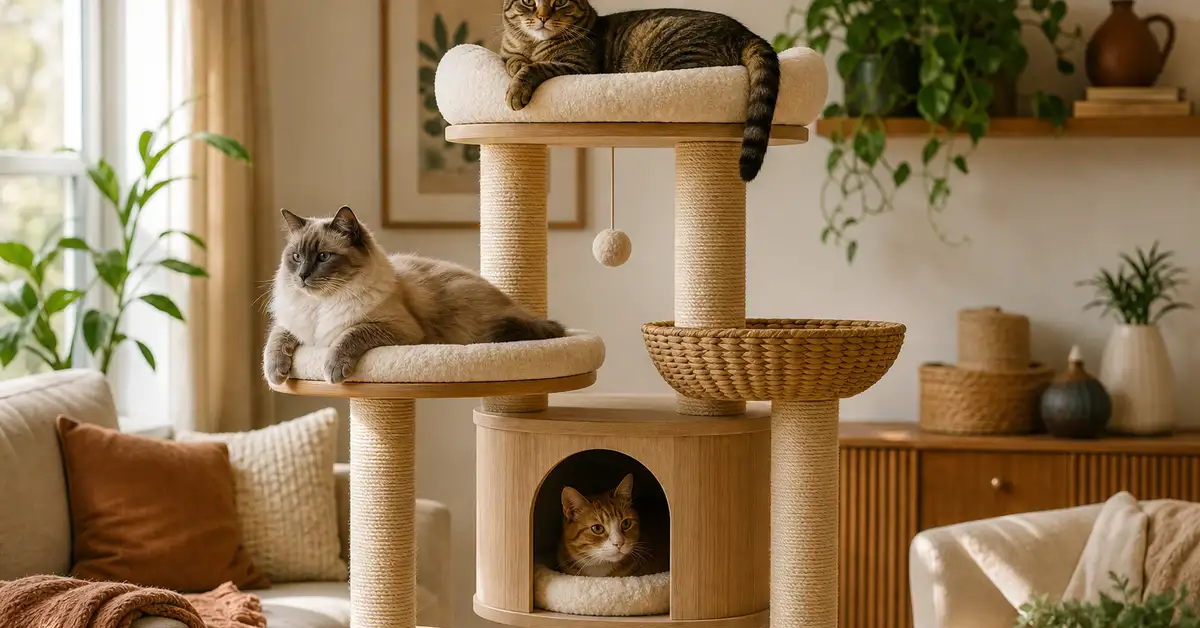
In a multi-cat household, the buying decision isn’t “will this hold my cat’s weight” — it’s “will this actually get used by more than one cat without becoming a flashpoint.” The ASPCA’s guidance on aggression between cats in the same household is direct on this: owners should “provide additional perches,” because “more hiding spots and perches will allow your cats to space themselves out as they prefer,” and should generally reduce resource competition rather than concentrate cats onto one shared structure. A single-perch, single-entrance tower asks cats who don’t fully get along to negotiate one doorway and one high spot — exactly the setup that creates conflict. A tree with multiple perches at different heights, more than one entry route into any enclosed condo, and enough total resting spots for the number of cats in the house gives less-confident cats a way to be up off the floor without a confrontation.
As a rule of thumb worth applying to every product below: count the total number of distinct resting surfaces (perches, condos, hammocks, baskets) and compare it to your cat count. A tree with three resting spots for three cats works very differently in practice than one with three spots for five cats, even if both are marketed as “multi-cat.” None of the manufacturers below publish a formal “cats per tree” rating with independent testing behind it — that number doesn’t really exist in this category — so treat perch/condo counts as the practical proxy.
Base Stability and Footprint With Multiple Cats Landing at Once
A tree that’s stable for one cat climbing carefully can behave differently when two cats land on different platforms within a few seconds of each other, or when a cat leaps rather than climbs to get past a housemate. Manufacturers rarely publish a “simultaneous multi-cat” stability rating; what they do publish is base footprint (a wider, heavier baseboard resists tipping better under uneven loading) and, less often, a per-platform weight limit. We’ve reported both wherever they’re published below, and said plainly where they aren’t. If a manufacturer sells an anti-tip wall-anchor kit, we’ve noted it — it’s a legitimate extra safety step in any home with more than one cat using a tree at once, and a couple of the picks below include one.
Transparency first: This guide contains affiliate links. If we’re enrolled in an affiliate program, we may earn a commission at no extra cost to you — it never affects how we research or rank. Read our full affiliate disclosure policy.
1. Frisco 78-in Faux Fur Cat Tree & Condo, Cream — Best Overall for Multiple Cats
What it is: A 78-inch freestanding multi-level tree with a full published dimensional table on its Chewy listing, two enclosed condos, and nine individually sisal-wrapped scratching posts.
Best for: Households wanting the tallest fully-specified multi-condo option on this list, with enough distinct posts and platforms that cats aren’t funneled through one climbing route.
Specs: Fully assembled 23.2″ L x 21.3″ W x 78″ H. Condo 1: 13.8″ x 13.8″ x 11.8″. Nine sisal-wrapped scratching posts, plush-covered platforms and condos, dangling toys engineered to release under excess pressure.
Manufacturer weight capacity: Not published as a number for this SKU.
Pros: The most fully documented multi-condo tree here; retailer copy states it’s “large enough to give multiple cats a place to play, sleep and scratch all at the same time”; nine separate scratching posts spread the climbing routes out.
Cons: No numeric weight rating to compare against other trees; a relatively narrow 23.2″ x 21.3″ footprint for its height, so anchor it to a wall in homes with enthusiastic climbers.
Price band: $$ (mid-range)
Evidence: Manufacturer/retailer listing, Chewy.
2. Frisco 72-in Large Base Faux Fur Cat Tree & Condo, Cream — Best Wide Base for Multi-Cat Traffic
What it is: A 72-inch tree from the same Chewy private-label line, built around a noticeably wider baseboard than most trees at this height, with ten sisal-wrapped posts and two scratch-board ramps.
Best for: Homes where several cats regularly climb, jump off, and land near the base at overlapping times — the wider footprint is the specific design answer to that.
Specs: Fully assembled 72″ H, with a 27.5″ x 23.5″ baseboard (noticeably wider than the 78-in sibling model above). Apartment/condo: 12″ x 19.5″ x 14.5″. Ten sisal-wrapped scratching posts plus two scratch-board ramps.
Manufacturer weight capacity: Not published as a number.
Pros: Retailer copy states the ten posts and two ramps “make this great for multi-cat households”; the wider base is a real, measurable stability advantage over most trees on this list, not marketing language.
Cons: Only one enclosed condo; shorter overall than the 78-in sibling, so fewer distinct height tiers.
Price band: $$ (mid-range)
Evidence: Manufacturer/retailer listing, Chewy.
3. Go Pet Club 72-in Tall Extra Large Cat Tree — Best Dual-Condo Design
What it is: A roughly six-level tree with two enclosed condos and a hanging toy, built from a compressed-wood core with faux fur covering and sisal-wrapped posts.
Best for: Households wanting two separate hiding spots on one tree, so two cats can each retreat into their own enclosed space rather than share one condo.
Specs: 22″ L x 33″ W x 72″ H (footprint reported both ways across retailers; treat as roughly a 22″×33″ base), dual enclosed condos across roughly six climbing levels.
Manufacturer weight capacity: Not published as a number.
Pros: Two full enclosed condos is genuinely useful for cats that want privacy rather than an open perch; retailer copy specifically markets it for multiple-cat households.
Cons: No published per-platform weight rating; like most trees in this price range, expect to check color/variant availability at the retailer before buying, since specific colorways come and go.
Price band: $$ (mid-range)
Evidence: Manufacturer/retailer listing, Walmart.
4. Go Pet Club 62-in Multi-Level Cat Tree — Best Budget Pick for Two Cats
What it is: A five-tier, 62-inch tree with one condo, a top perch, a hammock, and a basket bed — four distinct resting spots on one structure at one of the lower price points on this list.
Best for: Two cats of average size that want separate spots without needing the tallest or widest tree available.
Specs: 62″ H x 38″ W x 27″ D; base 26″ x 19″; condo roughly 13″ diameter; top perch 13.25″ x 13.25″. Compressed-wood core, faux fur covering, sisal rope posts.
Manufacturer weight capacity: Not published by the manufacturer; a retailer listing cites roughly 60 lb as a general guideline, which we could not independently confirm against a manufacturer spec sheet — treat it as a retailer estimate, not a tested rating.
Pros: Four separate resting spots (condo, perch, hammock, basket) at a genuinely accessible price; a straightforward layout that’s easy to place in a smaller room.
Cons: Owner feedback on this specific model notes some platforms run a little snug for larger-bodied cats — a better fit for two average-size cats than for three-plus or for large-breed cats specifically (see our best cat trees for large cats guide for that need instead).
Price band: $ (budget)
Evidence: Manufacturer/retailer listing, Amazon.
5. FEANDREA 45.3-Inch Cat Tower, Plush Condo with Scratching Post (UPCT141W01) — Best Compact Multi-Cat Tree
What it is: A compact, apartment-sized tower with one enclosed cave, two plush top perches, a ramp/scratch board, and five sisal posts — and the highest published whole-tower weight rating of any pick on this list.
Best for: Smaller living spaces where a full 70-plus-inch tree isn’t practical, but you still want more than one resting spot for two cats.
Specs: 45.3″ overall height; one enclosed cave, two plush perches, ramp/scratch board, five sisal-wrapped posts; pressed wood core with plush fabric covering.
Manufacturer weight capacity: 110 lb (50 kg) maximum static load, manufacturer-stated — the highest figure of any product in this guide — and it ships with an anti-tip wall-anchor kit.
Pros: A genuinely published, high weight-capacity figure most competitors don’t state at all; the wall-anchor kit is a real safety addition for a compact footprint; small enough for apartments while still offering three distinct resting spots (cave plus two perches).
Cons: Only one enclosed hiding spot, so it suits two cats better than three or more; shorter than every other pick here, which means less total vertical separation between cats.
Price band: $ (budget)
Evidence: Manufacturer/retailer listing, Amazon.
6. Armarkat Classic Cat Tree B8201 — Best for 3–4+ Cats
What it is: An 82-inch tree with two enclosed condos and three perches, sold directly by the manufacturer with a full published spec sheet and years of genuine, dated owner reviews describing multi-cat households using it.
Best for: Larger cat groups — owner reviews on the manufacturer’s own site describe three, four, and even six cats sharing this specific tree.
Specs: Overall 45″ L x 36″ W x 82″ H; base 28″ x 24″; two condos, 20″ x 16″ x 14″ and 20″ x 16″ x 12″; three perches at 15″ x 15″; 3.5″ post diameter. Pressed wood board, faux fleece covering, natural sisal rope, includes a ramp.
Manufacturer weight capacity: 100 lb maximum holding weight, manufacturer-stated directly on Armarkat’s own product page.
Pros: Five total resting spots (two condos, three perches) at a published 100 lb capacity; genuine owner reviews on the manufacturer’s own site independently describe multi-cat use — one reviewer specifically notes three cats using the three perches, another describes six cats using the tree.
Cons: At 82″ tall with a 45″ x 36″ footprint, this needs real floor space and ceiling clearance; priced above most of this list.
Price band: $$$ (premium)
Evidence: Manufacturer listing, Armarkat.
7. Prestige Cat Trees Staggered Cat Tower 130098 — Best Multi-Perch Design
What it is: A solid-wood, USA-handcrafted tower built around five open, staggered resting platforms rather than an enclosed condo — a deliberately different layout from every other pick on this list.
Best for: Households wanting maximum simultaneous perch access rather than a hiding spot — the staggered, open-platform design is explicitly positioned by the manufacturer for large and multi-cat homes.
Specs: Roughly 23″ W x 23″ D x 71″ H per the manufacturer’s current listing; five distinct resting/activity areas (upper lounging perch, curved hammock perch, observation platform, carpeted play tunnel, and additional elevated levels); solid wood posts, premium household-grade carpet, natural unoiled sisal rope; 65 lb assembled product weight.
Manufacturer weight capacity: Not published as a numeric per-cat or per-platform rating; the manufacturer states only that it’s built for “large cat breeds” and “multi-cat homes.”
Pros: Solid wood construction (not particleboard) is a genuine durability difference from most of this list; a manufacturer product page section titled “Built for Large Cats & Multi-Cat Homes”; a verified customer review describes running two of these towers for six cats.
Cons: No enclosed condo at all, so cats that want to hide fully rather than perch openly won’t get that here; no published numeric weight rating; the most expensive pick on this list.
Price band: $$$ (premium)
Evidence: Manufacturer listing, Prestige Cat Trees.
8. Yaheetech 76-in Large Cat Tree Multi-Level Tower — Best Value for Two to Three Cats
What it is: A 76-inch tower with two condos, three perches, a basket, and eight scratching posts, sold directly by the manufacturer with a specific, published multi-cat capacity statement.
Best for: Two to three normal-sized cats, or several kittens, per the manufacturer’s own stated use case — not for larger or heavier cats sharing platforms simultaneously.
Specs: Overall 22″ L x 22″ W x 76″ H; base 22″ x 22″ x 1.2″ thick; condo 14″ L x 14″ W x 12″ H; door 8.7″ W x 9″ H; perch diameter 14″; basket diameter 14.4″. Two condos, three perches, one basket, eight scratching posts, one scratching board, three hanging balls, one ramp. Particleboard core, plush covering, sisal rope. Net assembled weight 44.1 lb.
Manufacturer weight capacity: 5 kg / 11 lb maximum per perch, condo, or basket, manufacturer-stated — a genuinely low figure worth knowing before buying.
Pros: The manufacturer states plainly, in its own words, that this tree is “suitable for two or three normal-sized cats or several kittens”; two condos plus three perches gives five separate resting spots at one of the lower price points on this list.
Cons: The published 11 lb per-platform limit is low compared with the whole-tower ratings published by FEANDREA and Armarkat above — fine for average-weight cats using one platform at a time, but not a tree to buy expecting several heavier cats piling onto one perch together.
Price band: $$ (mid-range)
Evidence: Manufacturer listing, Yaheetech.
How Many Cats Can Actually Share One Tree?
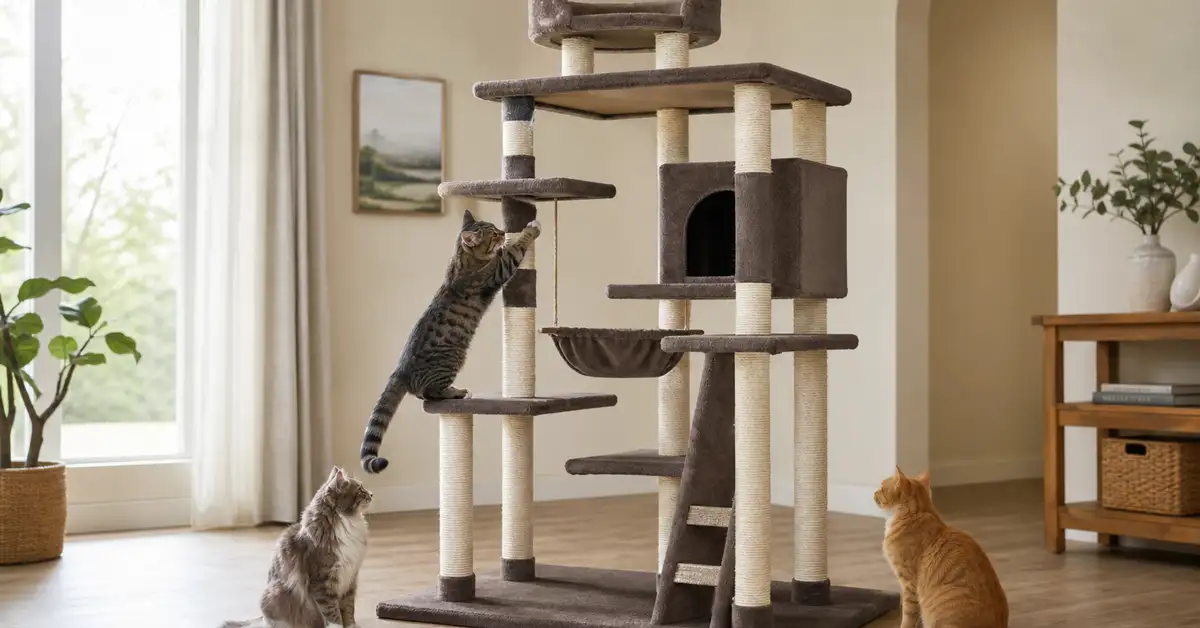
There’s no independently tested “cats per tree” industry standard — every number you’ll see, including the manufacturer capacity claims above, is a marketing estimate rather than a measured result. The more reliable approach is the one the ASPCA’s guidance points toward: count resting spots, not advertised cat counts, and match that to how many cats actually need to use the tree at once. A tree with five distinct perches and condos (like the Armarkat B8201 above) genuinely accommodates more simultaneous use than a tree with three, regardless of what either box says on the front. If your cats already get along well, capacity matters more than layout. If any of your cats actively avoid each other, an additional consideration matters just as much: whether the tree offers more than one way up and down, so a less-confident cat isn’t cornered.
If litter box competition is also a factor in your multi-cat home — a very common pairing with tree/perch competition — see our best litter boxes for multiple cats guide, which covers the same one-per-cat-plus-one resourcing principle.
Frequently Asked Questions
Methodology & Sources
Product specifications, dimensions, and stated weight capacities above are drawn directly from each manufacturer’s or retailer’s own published listing, linked in the Evidence line under each pick. Behavioral guidance on multi-cat resource competition is drawn from the ASPCA’s published guidance on aggression between cats in the same household. Our October 2026 search of the US CPSC recall database found no recall for any cat tree recommended above. This is general buying guidance based on published specifications and behavioral-authority sourcing, not a substitute for a veterinarian’s or certified behaviorist’s assessment of a specific multi-cat household conflict.