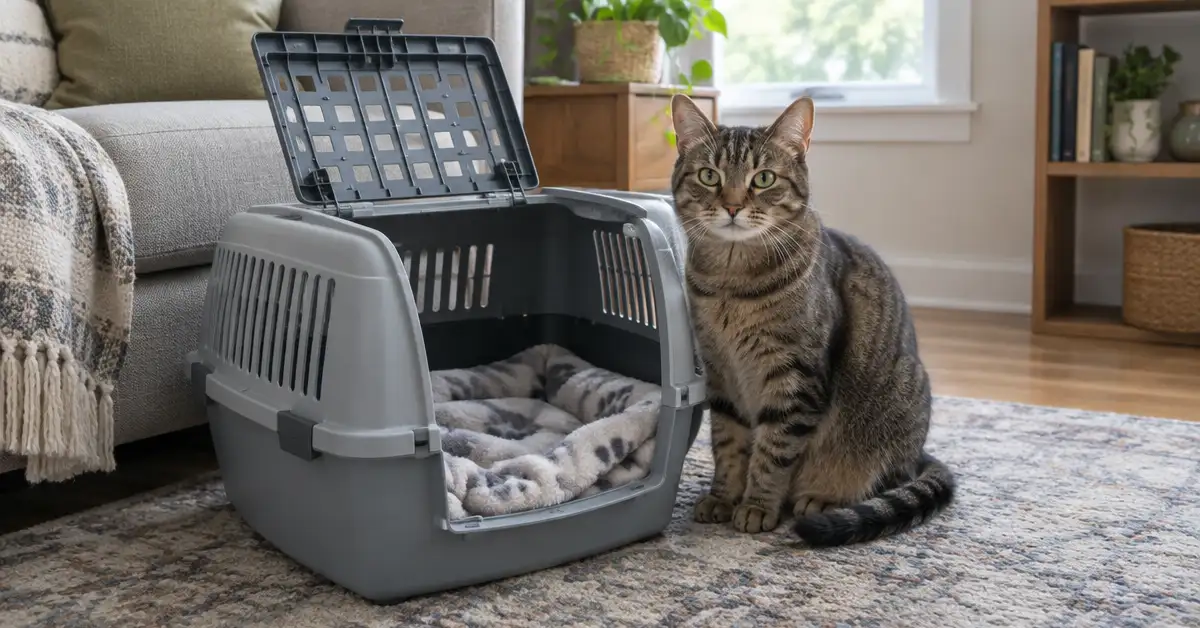
Updated for 2026. Veterinary and feline-welfare guidance points to a short list of carrier design traits: a hard or structured body, an opening on top so the cat can be lowered in rather than pushed through a front door, secure latches or locking zippers, ventilation, and a size that fits the cat without leaving room to tumble around. International Cat Care and the American Association of Feline Practitioners (AAFP) describe most of those traits, and we sorted the 8 carriers below against them. Each pick’s exact size or variant was checked against the maker’s own page or a named retailer’s listing, and each specification below is written as that source gives it.
This is a gear guide. If your cat resists the carrier before you even pick it up, our guide to getting a cat into a carrier covers the handling side, and our cat gear guide covers everything else a new cat parent needs.
How We Chose
We started from the design guidance in two published veterinary-organization sources: the AAFP’s Cat Friendly Homes handout Visiting Your Veterinarian and International Cat Care’s Taking your cat to the vet. We then kept only carriers where a maker page or a retailer listing names the exact size and variant we recommend. Price bands use this ladder: under $25 · $25–75 · $75–150 · $150–300 · $300–700 · $700+. Each band is set from the exact item’s price on the maker’s store or the retailer named in that pick’s Evidence line (Petmate’s store, Chewy, Sherpa’s store and Amazon, Sleepypod’s store, PetSmart, PetLuv’s store, Amazon for the Petseek), read in October 2026. Prices move, so check the listing before you buy.
We did not test any carrier here. We read published specifications and say so. The Center for Pet Safety (CPS) runs an independent crash-test certification program, and we cite a crash-test claim only where CPS’s own certified list names the product. Two of the eight picks appear on that list, the Sleepypod Air and the Sleepypod Mobile Pet Bed. The other six get no crash-test claim from us, whatever their makers say.
What the Guidance Says to Look For in a Carrier
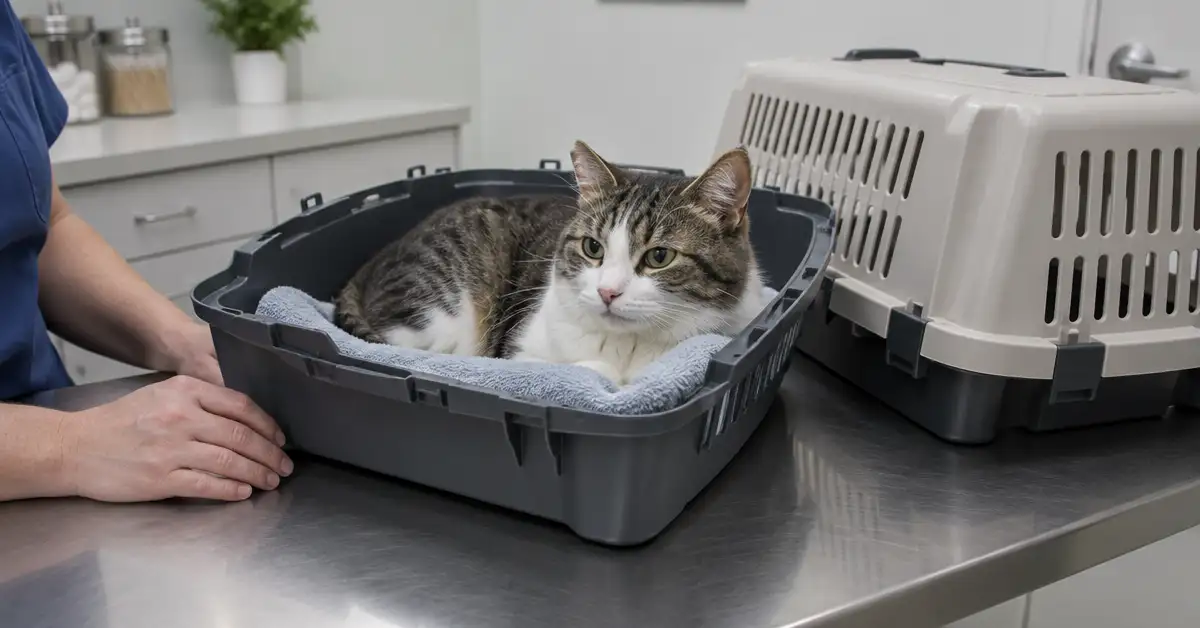
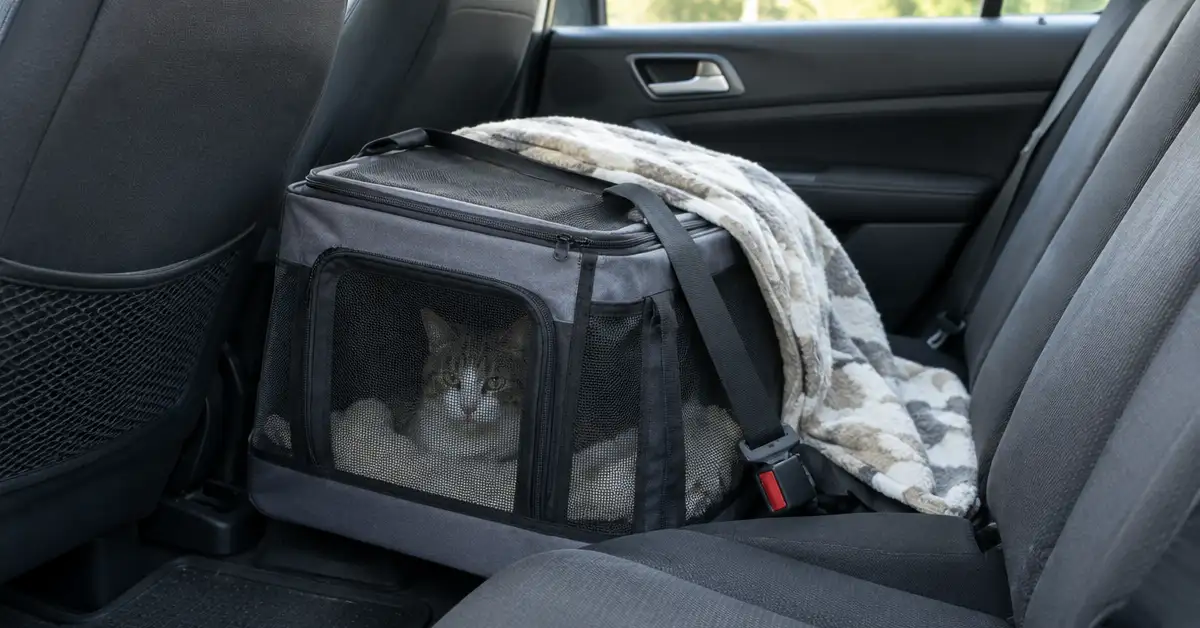
The AAFP handout states that a hard plastic carrier is the safest and easiest to clean compared with other carrier types, and recommends one with a top that comes off, so the cat can stay in the bottom half during the exam. For soft carriers it asks for a large opening at the top and one, or preferably two, door openings, with no door that can collapse when opened. It also says backpack-style carriers do not give a cat enough room to move and can feel unstable. International Cat Care adds that a carrier that opens at the top is much easier to use because the cat can be gently lifted in or out, and that the carrier should be easy to clean and not so large that the cat falls about in it. Both sources suggest covering the carrier with a cloth or towel while traveling, and both say to secure it in the car and to hold it underneath rather than by the handle alone.
One caution applies to the two large-format picks near the end. The AAFP says each cat should have its own carrier, even cats that get along, because the strain of travel can change how they act toward each other. Where a maker says its carrier fits two cats, we quote that as the maker’s claim and do not rank on it.
Specifications at a Glance
| Pick | Build | Entry points (as the source words them) | Size figure (source) | Weight rating (source) | Band |
|---|---|---|---|---|---|
| Petmate E-Z Load Two Door, 24-in | Hard plastic and steel wire | Two doors; top-load design | Interior 21 x 14.5 x 13.5 in (Petmate) | Up to 15 lb (Petmate) | $25–75 |
| Frisco Two Door Top Load, Gray, 20-in | Hard plastic, wire mesh doors | Wire mesh top and front | Interior 17.9 x 11.9 x 10.2 in (Chewy) | Not disclosed | $25–75 |
| Sherpa Original Deluxe, Charcoal, Medium | Soft-sided, spring wire frame | Top and side entries | 17 x 11 x 10.5 in (Sherpa’s Amazon listing) | Up to 16 lb (Sherpa’s Amazon listing) | $25–75 |
| Sleepypod Air | Soft-sided, stiff base | Top and side entry | Interior 15–21 x 9.5 x 9.5 in (Sleepypod) | Rated to 18 lb (Sleepypod, CPS) | $150–300 |
| Sleepypod Mobile Pet Bed | Bed base with zip-on mesh dome | Dome zips onto the bed | See Sleepypod’s dimensions list | Rated to 15 lb (Sleepypod, CPS) | $150–300 |
| Travel Cat The Transpurrter, Aqua | Soft-sided, structured frame | Top and both sides, plus a slide-out bed (PetSmart) | 10.5 x 19 x 11 in (PetSmart) | Not stated (PetSmart) | $150–300 |
| PetLuv Premium, Large | Soft-sided, internal metal frame | Three sides and top | 24 x 16 x 16 in (PetLuv) | 45 lb maximum (PetLuv) | $75–150 |
| Petseek Extra Large, Gray | Soft-sided, iron support frame | Side, top and front | 24 x 16.5 x 16 in (Petseek, on Amazon) | Up to 55 lb (Petseek) | $25–75 |
Transparency first: This guide contains affiliate links. If we’re enrolled in an affiliate program, we may earn a commission at no extra cost to you — it never affects how we research or rank. Read our full affiliate disclosure policy.
1. Petmate E-Z Load Two Door Top Load Kennel, 24-in — Best Overall for Anxious Cats
What it is: A hard-sided kennel in heavy-duty plastic and steel wire with a top-load door and a front door, in the 24-inch size that Petmate rates for pets up to 15 pounds.
Best for: Carrier-averse cats under 15 pounds whose owner wants the construction the AAFP names first: a hard plastic shell with an opening on top.
Specs (Petmate): Interior 21 x 14.5 x 13.5 inches; listed product weight 6.43 pounds; made in the USA from EcoTEC plastic with other components imported, per Petmate.
Pros: The top-load door lets you lower a cat in rather than steer it through a front opening, which International Cat Care describes as much easier to use; hard plastic is the easiest material to clean; Petmate describes the steel-wire doors as giving good ventilation.
Cons: Petmate’s page describes the top-load door and assembly but does not describe taking the top half off for a vet exam, so check how the halves separate before relying on that; the 15-pound rating rules out larger cats; the page lists both 19-inch and 24-inch sizes, so choose the 24-inch.
Price band: $25–75
Recall check: No recall found for this carrier in our October 2026 CPSC search.
Evidence: Manufacturer listing, Petmate (24-inch variant).
2. Frisco Two Door Top Load Plastic Kennel, Gray, 20-in — Best Compact Top-Loader
What it is: Chewy’s house-brand hard plastic kennel with wire mesh front and top doors, in the gray 20-inch size.
Best for: A small cat or kitten, or a household that wants a second hard carrier for the car or a spare room.
Specs (Chewy): Interior 17.9 x 11.9 x 10.2 inches; exterior 20.3 x 12.9 x 11.6 inches; carrier weight 3.3 pounds per a Chewy answer on the listing. The Chewy listing we read gives no weight rating.
Pros: The same hard-shell, top-and-front-door layout as the Petmate, from Chewy’s house brand; the listing describes two halves that snap together and lock with side clips and bolts, and the top half stacks inside the bottom for storage; Chewy advises leaving about 4 inches of room beyond a seated cat’s measurements.
Cons: Chewy’s own FAQ says the kennel is not escape proof; the 17.9-inch interior length may be short for a large adult cat, so check it against your cat’s measurements; the listing describes assembly with clips and bolts but does not promise a top that owners can remove for a vet exam.
Price band: $25–75
Recall check: No recall found for this carrier in our October 2026 CPSC search.
Evidence: Retailer listing, Chewy (Gray, 20-in).
3. Sherpa Original Deluxe Travel Pet Carrier, Charcoal, Medium — Best Soft-Sided with Top Entry
What it is: A soft-sided carrier with a spring wire frame, mesh panels, locking zippers, and both a top and side entry, in the Medium size and Charcoal color.
Best for: Cats that will not accept a hard shell but will go into a soft one, and owners who want an opening on top.
Specs: 17 x 11 x 10.5 inches and fits pets up to 16 pounds, per Sherpa’s own bullet text on its Amazon listing.
Pros: Top and side entry, which the AAFP asks soft carriers to have, though Sherpa does not state the size of the top opening; mesh panels for ventilation and locking zippers (Sherpa); a removable machine-washable liner and waterproof base (Sherpa).
Cons: The AAFP names hard plastic as the safest and easiest to clean, so this is the compromise pick; neither the Sherpa nor the Amazon listing we read says whether the doors hold their shape when open, which the AAFP asks soft carriers to do. Sherpa describes it as airline approved and part of its Guaranteed On Board program; that is the maker’s claim, so confirm current under-seat limits with your airline.
Price band: $25–75
Recall check: No recall found for this carrier in our October 2026 CPSC search.
Evidence: Retailer listing, Amazon (Charcoal Gray, Medium) and Manufacturer listing, Sherpa (SKU 55553).
4. Sleepypod Air — Best Soft-Sided with a CPS-Listed Crash Test
What it is: A soft-sided carrier with top and side entry, a stiff base, a removable privacy panel, and a trolley pocket that slides over a wheeled suitcase handle.
Best for: Cats up to 18 pounds, and owners who want a carrier that doubles as a car seat with independent crash-test backing.
Specs (Sleepypod): Interior 15 to 21 inches long x 9.5 wide x 9.5 tall (the length changes as the carrier compresses); carrier weight 4 pounds, or 4.5 with the privacy shield; rated to 18 pounds.
Crash testing: The Center for Pet Safety’s own certified-products list names the Sleepypod Air, and its page for the product records a January 2025 test at an 18-pound test weight. We do not reproduce CPS’s rating.
Pros: Top and side entry, which the AAFP asks of soft carriers; a privacy panel that blocks the view while keeping airflow (Sleepypod); washable bedding that lets the carrier double as a bed at home, which fits International Cat Care’s advice to make the carrier part of the furniture.
Cons: It sits in the $150–300 band, above the Sherpa and Petseek; the 18-pound ceiling excludes larger cats; Sleepypod cautions against using non-Sleepypod accessories with its carriers.
Price band: $150–300
Recall check: No recall found for this carrier in our October 2026 CPSC search.
Evidence: Manufacturer listing, Sleepypod and Center for Pet Safety certified-product page.
5. Sleepypod Mobile Pet Bed — Best Bed-Style Carrier
What it is: A pet bed with a ballistic nylon base that becomes a carrier when a mesh dome is zipped onto it.
Best for: A cat that already sleeps in a bed and might accept a carrier that starts out as one. Cats up to 15 pounds.
Specs (Sleepypod): Rated to 15 pounds. Sleepypod lists the dimensions on its product page; check them against your cat’s measurements.
Crash testing: CPS’s own certified-products list names the Sleepypod Mobile Pet Bed, and its page records an August 2024 test at a 15-pound test weight. We do not reproduce CPS’s rating.
Pros: Leaving the bed out at home is the “part of the furniture” approach International Cat Care describes; a CPS-listed test for the car; the dome comes off and the base stays as an open bed.
Cons: A lower weight rating than the Air; a soft shell, not the hard plastic type the AAFP names as safest and easiest to clean; it sits in the $150–300 band.
Price band: $150–300
Recall check: No recall found for this carrier in our October 2026 CPSC search.
Evidence: Manufacturer listing, Sleepypod and Center for Pet Safety certified-product page.
6. Travel Cat The Transpurrter Convertible Cat Carrier, Aqua — Best Multi-Entry Carrier
What it is: A soft-sided carrier with a structured frame and entry points on the top and both sides, plus a slide-out bed with a handle. It also has a waterproof lining, a washable fleece mat and a sleeve for rolling luggage.
Best for: A cat that resists one particular entry route, and owners who want a choice of openings.
Specs: PetSmart’s listing for the Aqua version (item 5384777) gives 10.5 x 19 x 11 inches and a total weight of 3.4 pounds. The 30-pound weight limit comes from Costco’s page for the Heather Gray version of the same carrier; PetSmart’s page does not state a limit.
Pros: Three entry points plus the slide-out bed, which is as many openings as the PetLuv in a much smaller carrier; buckles and straps to secure it with a seatbelt (PetSmart), and two interior clips for a harness or leash attachment (Costco).
Cons: The listing counts a backpack as one of five carrying options, and the AAFP warns that backpack-style carriers can be cramped and unstable, so use the handle, shoulder strap or car fastening instead; the 19-inch length is shorter than the 24-inch carriers; neither retailer listing we read gives interior dimensions.
Price band: $150–300
Recall check: No recall found for this carrier in our October 2026 CPSC search.
Evidence: Retailer listing, PetSmart (Aqua) and Retailer listing, Costco (Heather Gray).
8. Petseek Extra Large Soft-Sided Carrier, Gray — Best Value Large-Format Carrier
What it is: A soft-sided carrier with an iron support frame, Oxford fabric and nylon mesh, with side, top and front openings, a zipper lock on each, and breathable netting on five sides.
Best for: A large cat on a tighter budget than the PetLuv. This is the Gray, without-curtain version.
Specs (Petseek): 24 x 16.5 x 16 inches; Petseek says it holds pets up to 55 pounds. Petseek’s listing title says the carrier is for two cats; the AAFP says each cat should have its own carrier, so we are not recommending it for two.
Pros: Three openings and zipper locks (Petseek); seatbelt loops on the side (Petseek); the lowest band of the large carriers here.
Cons: Petseek says its only support channel is Amazon’s buyer-seller messaging; a 55-pound rating is a ceiling, not a fit guide, and International Cat Care advises against a carrier so large that the cat falls about in it.
Price band: $25–75
Recall check: No recall found for this carrier in our October 2026 CPSC search.
Evidence: Retailer listing, Amazon (Gray, without curtain).
Picking a Size
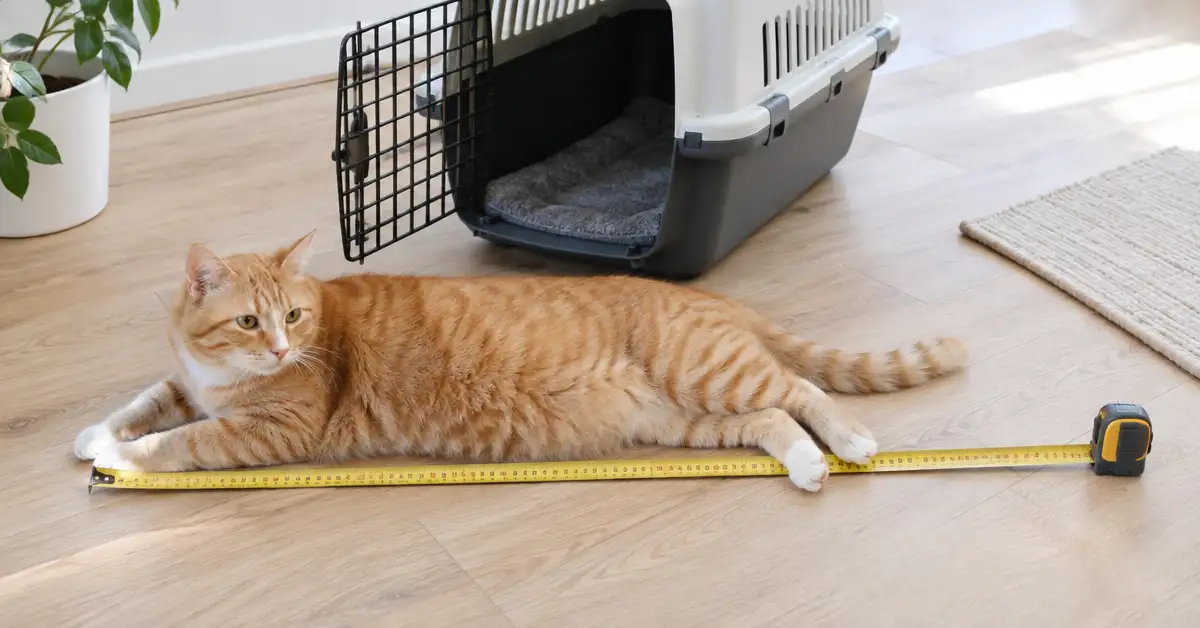
International Cat Care says a carrier should not be so large that the cat falls about in it, and Chewy’s Frisco listing suggests measuring a seated pet and allowing about 4 inches of space compared with the interior dimensions. Use the interior figures where a maker publishes them, and read a weight rating as a ceiling rather than a recommendation. Where only exterior dimensions are published, the usable space inside is smaller.
Frequently Asked Questions
Methodology & Sources
Product specifications above come from each maker’s or a named retailer’s own published page, linked in the Evidence line under each pick, and are written in the source’s own words and units. Design guidance comes from the AAFP’s Cat Friendly Homes handout and International Cat Care, linked in How We Choose. Crash-test statements come only from the Center for Pet Safety’s own certified-product pages. Our October 2026 search of the US CPSC recall database found no recall for any carrier recommended above. Michael Probert, our author, is a longtime multi-cat owner writing from research and lived experience, not clinical or veterinary expertise — see our About page. We have no in-house veterinary reviewer, and none of the carriers above were tested hands-on for this guide; this is research-led buying guidance, not a lab test. Full editorial policy: How We Choose.
Excluded because we could not verify the exact recommended variant: the Amazon Basics 2-Door Top-Load carrier (we could not confirm the price band for the exact size) and the Mr. Peanut’s Gold Series Standard and Big Apple carriers (the maker’s product pages would not load for us).
Sources: AAFP Cat Friendly Homes, Visiting Your Veterinarian; International Cat Care, Taking your cat to the vet; Center for Pet Safety, certified products; manufacturer and retailer listings linked throughout; screened against the US Consumer Product Safety Commission (CPSC) recall database (October 2026 search; no recall found for any recommended carrier).
See our guide to getting a cat into a carrier for the handling side, or our full cat gear guide for everything else a new cat parent needs.