Updated for 2026. For a lot of cats, the carrier only ever appears right before something unpleasant happens — a car ride, a vet visit, a struggle. That association can turn a simple piece of equipment into the most dreaded object in the house. The good news is that this is a trained response, and it can be retrained: with a short, patient, treat-led process, most cats can learn to walk into a carrier on their own. This guide covers why cats resist carriers in the first place, a genuine step-by-step desensitization process, what to do if you need your cat in a carrier right now and don’t have weeks to prepare, and which carrier features make the whole process easier.
This is general behavioral guidance for cat owners, not veterinary or professional behaviorist advice. We have no in-house veterinary reviewer. If your cat is aggressively resistant, becomes distressed beyond what these techniques address, or you’re not confident handling a stressed cat safely, a vet or a certified feline behaviorist can help.
Why Cats Resist Carriers
Cats are a prey species as well as predators, and that shapes a lot of their instinctive behavior: being picked up, confined, and carried into a small enclosed box hits several of their natural alarm triggers at once — loss of control, loss of an escape route, and unfamiliar motion. For most cats, that reaction is compounded by learning: if the only times the carrier appears are followed by a car ride and a vet visit, the carrier itself becomes a predictor of something stressful, the same way a doorbell can make a dog anticipate a visitor. The Fear Free veterinary-behavior program notes that cats trained to enter a carrier willingly showed measurably less stress on the car ride and had shorter veterinary exams than cats who were forced in — the resistance isn’t stubbornness, it’s a learned and largely avoidable stress response.
How to Get Your Cat Used to Its Carrier, Step by Step
This process works by breaking the carrier down into small, non-threatening pieces and pairing each one with something your cat already likes — food. Go at your cat’s pace: some cats move through every step in a few days, others (especially adult cats with an existing bad association) take weeks or months. Keep sessions short — a minute or two, a handful of treats, several times a day — and never force a step your cat isn’t ready for.
1. Leave the carrier out, permanently
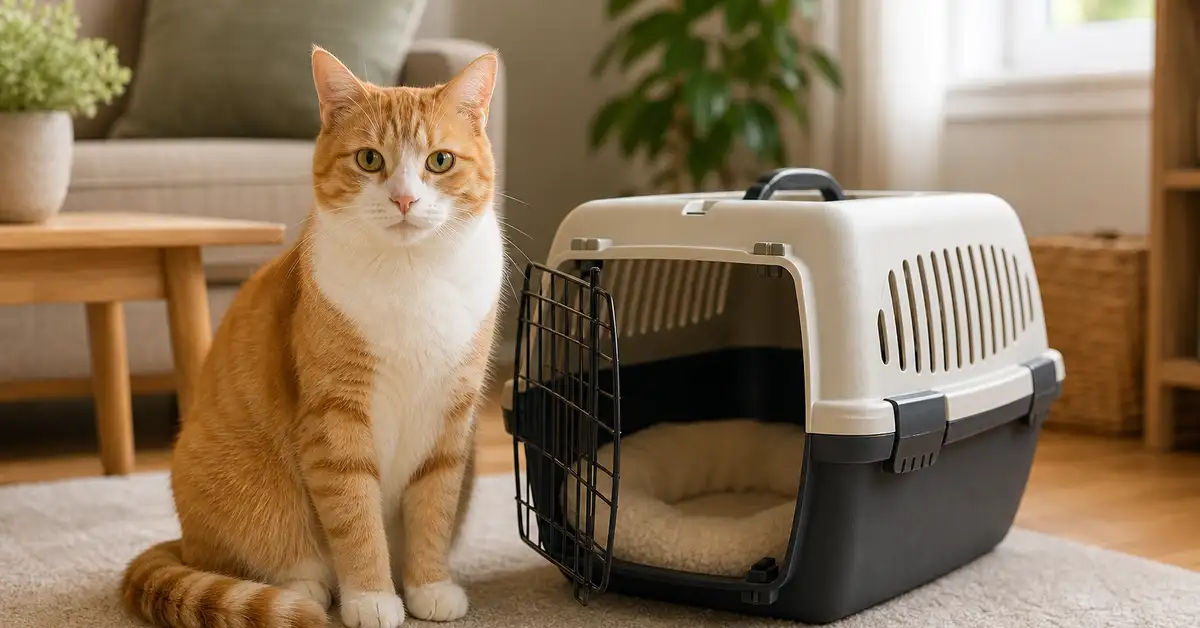
Put the carrier somewhere your cat already spends time — not in a closet you only open before a vet trip. Prop the door open, add a soft blanket or familiar bedding inside, and consider draping a towel over part of it so it feels more like a den than an open box. A carrier that’s simply part of the furniture stops being a novel, alarming object the moment it appears.
2. Build a positive association with food
Start feeding meals near the carrier, then gradually move the food bowl closer over several meals until your cat is eating right at the entrance. Once that’s comfortable, move the bowl a little further inside each time — first just inside the door, then toward the back — until your cat is walking fully inside to eat every meal. Scatter a few treats inside between meals so your cat finds the carrier rewarding to explore on its own, not just at mealtimes.
3. Practice closing the door
Once your cat is reliably eating every meal fully inside the carrier, start gently closing the door for just a few seconds while your cat is still eating or has just finished, then open it again. Extend the closed-door time gradually over multiple short sessions, offering treats through the door or grate the whole time. If your cat shows any sign of distress — scratching to get out, vocalizing, flattened ears — go back to a shorter closed-door time and rebuild from there rather than pushing through it.
4. Practice picking it up and short trips
With the door closed and your cat calm inside, practice lifting the carrier a few inches, setting it back down, and treating through the door. Gradually build up to carrying it a few steps around the house, then out to the car and back without actually driving anywhere. Once that’s routine, try a short drive around the block that ends back at home rather than at the vet — so the carrier and car aren’t exclusively associated with an unpleasant destination.

If You Need to Get Your Cat In Right Now (Emergency Method)
Sometimes there’s no time for gradual training — an urgent vet visit, a sick cat, a household emergency. If your cat isn’t carrier-trained and you need to move fast, handle this carefully rather than chasing or grabbing:
Approach calmly and scoop your cat up with both hands, supporting their chest and hindquarters rather than gripping around the middle or scruffing hard, which can cause pain, especially in cats with underlying joint or spinal sensitivity. If your cat is struggling or you’re worried about being scratched or bitten, drape a towel over your cat’s body first, then gently gather it around them — snug enough to keep their limbs from flailing, loose enough that they can breathe freely and it doesn’t restrict their chest — and lower the towel-wrapped cat into the carrier, closing the door before unwrapping the towel from around them, or leaving the towel in with them.
Don’t force a cat in head-first, and don’t shove or drop them in. Forcing a resistant cat’s head and shoulders into a carrier door against its will is both highly distressing and a real physical-injury risk to the cat’s neck, spine, and limbs, and to your hands. A top-loading or removable-top carrier makes this dramatically safer and easier, since you can lower a cat straight down into the body of the carrier rather than posting them through a narrow front door they’re actively resisting.
Carrier Features That Make This Easier
The training process above works with any carrier, but some features genuinely reduce the friction, especially during the early stages or in an emergency:
- Top-loading or removable-top design — lets you lower a cat straight down rather than posting them through a front door, which is both easier for you and considerably less stressful for a reluctant cat.
- Size — your cat should be able to stand up, turn around, and lie down comfortably inside; a carrier that’s too snug adds to the stress, and one that’s too large can feel less secure and let a cat slide around during transport.
- A cover or partial cover — a towel or blanket draped over part of the carrier reduces visual stimulation from a moving environment, which many cats find calming both at home during training and during actual travel.
- Familiar bedding — a blanket or towel that already smells like your home (or your cat) inside the carrier makes it feel less like foreign territory.
If you haven’t picked a carrier yet, our cat gear guide covers what to look for across hard-sided and soft-sided options in more depth — and once you’ve picked one, everything above applies to it directly.
Frequently Asked Questions
Methodology & Sources
This guide is research-led, not based on hands-on veterinary or professional behaviorist practice. Michael Probert, our author, is a longtime multi-cat owner writing from research and lived experience — see our About page. We have no in-house veterinary reviewer; behavioral and health-related information here is general and not a substitute for professional veterinary or behaviorist advice.
Sources: ASPCA, Fear Free Happy Homes, Cat Friendly Homes (AAFP), and International Cat Care (iCatCare).
See our full cat gear guide for what to look for in a carrier and everything else a new cat actually needs.