Updated for 2026. If your cat seems to barely touch its water bowl, it’s easy to assume the worst — but for many cats, especially those eating wet food, that’s actually normal. Cats evolved from desert ancestors, and much of their daily water can come from food rather than the bowl. That said, real changes in drinking — either much less or much more — can be an early sign of a health problem that genuinely needs a vet, not a new bowl. This guide covers what’s normal, the everyday reasons cats drink less than owners expect, what the actual research says about water fountains, and when a change in drinking behavior is worth a call to your veterinarian.
This is general information for cat owners, not veterinary advice. We are not veterinarians and have no in-house vet reviewer — if you’re concerned about your cat’s drinking, eating, or urination, please contact your vet rather than relying on this article to diagnose anything.
How We Researched This
This guide draws on the ASPCA’s general cat-care guidelines, Cornell University College of Veterinary Medicine’s Feline Health Center, VCA Animal Hospitals, PetMD, Royal Canin’s veterinary academy resources, Hill’s Pet Nutrition, and two peer-reviewed, published studies on cats’ response to different water-presentation methods (Grant et al. and Robbins et al., both indexed on PubMed Central). We’ve deliberately kept the medical sections at a general-information level — describing what to watch for, never diagnosing — and flagged every point where the only responsible next step is a vet visit. Full policy: How We Choose.
Why Many Cats Barely Seem to Drink — And Why That Can Be Normal
Domestic cats descend from desert-adapted wildcats that met most of their water needs through prey rather than standing water, and their kidneys are remarkably good at concentrating urine to conserve fluid. That evolutionary legacy means a healthy cat eating canned food can look like it “never drinks” while still being completely fine, because wet food is roughly 70–80% water, versus about 6–10% in dry kibble. A 10-lb cat needs somewhere around 8 oz (one cup) of total water a day from all sources combined — food, metabolic water, and drinking. If most of that 8 oz is already coming from a can of wet food, there may only be an ounce or two left for the bowl to supply, which is easy to miss entirely.
The flip side is that a cat eating only dry food needs to make up nearly the whole 8 oz from drinking, so the same “barely touches the bowl” observation means something very different depending on diet. Cornell’s Feline Health Center and VCA Animal Hospitals both frame the daily estimate the same way: roughly 4 oz of water per 5 lb of body weight, adjusted up or down for how much moisture is already in the food.
Everyday Reasons Cats Drink Less Than You’d Expect
Before assuming a medical problem, it’s worth ruling out the ordinary, fixable reasons cats avoid their water bowl:
- Stale or off-tasting water. Cats have a sharp sense of taste and smell, and many won’t drink water that’s sat out too long, picked up food particles, or tastes like plastic or detergent residue. Wash and refill bowls daily with fresh water.
- Whisker fatigue. Cats’ whiskers are sensitive, and some genuinely dislike the sensation of them brushing the sides of a narrow or deep bowl. A wide, shallow bowl filled close to the top can make a real difference.
- Bowl material. Plastic can hold onto odors and develop microscopic scratches that harbor bacteria. Glass, stainless steel, or glazed ceramic tend to be better-received.
- Placement next to food or the litter box. Veterinary behavior guidelines (AAFP/ISFM) recommend keeping water, food, and litter boxes in separate locations — cats instinctively avoid drinking near where they eliminate.
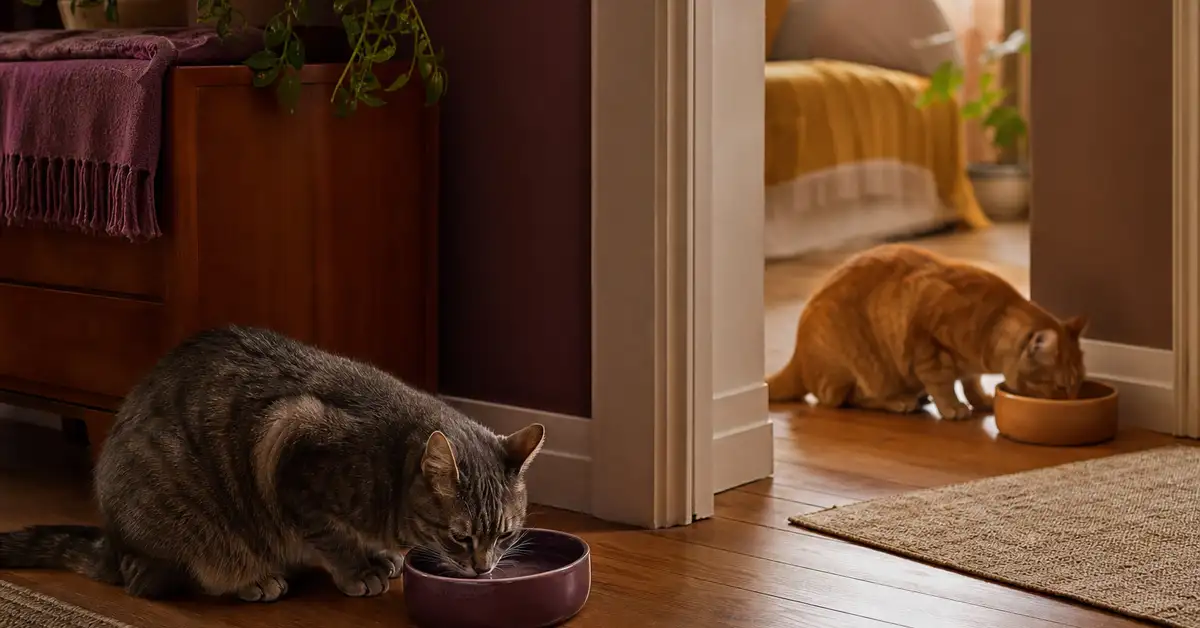
- Competition in multi-cat homes. A more confident cat can quietly “guard” the water bowl, blocking a shyer cat without any obvious conflict. One water station per cat, in different rooms, helps everyone get equal access.
- Temperature preference. Some cats prefer cold water straight from the tap; others are put off by ice-cold water if they have sensitive teeth. It’s worth experimenting.
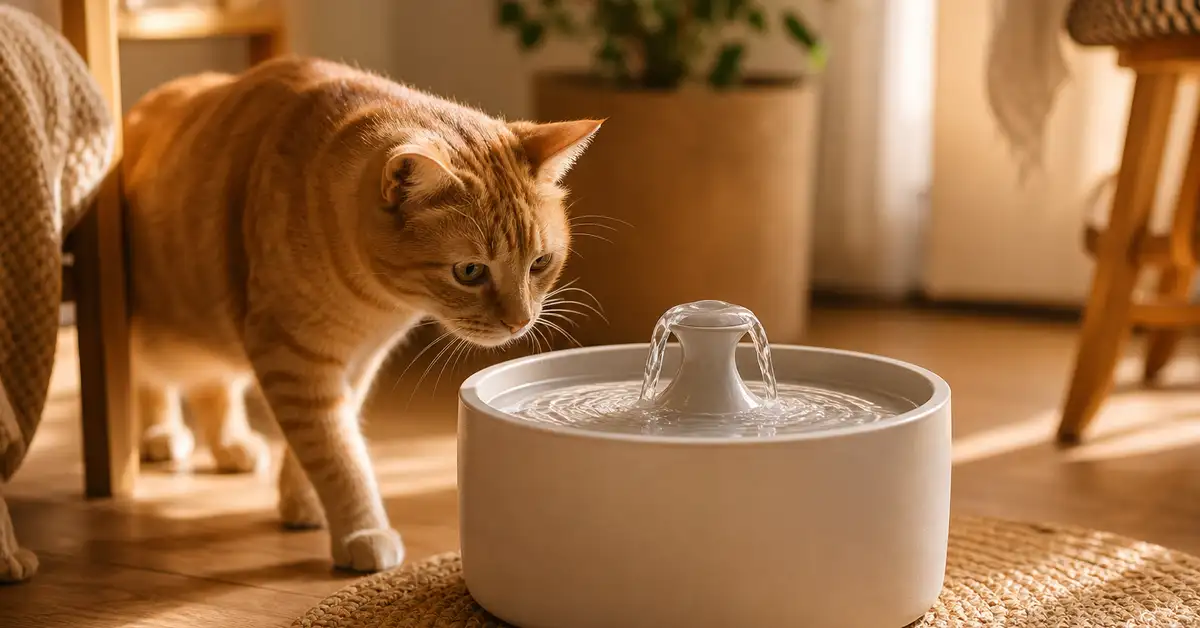
- A preference for moving water. Many cats are drawn to a dripping tap, a shower, or a fountain over a still bowl — which brings us to the next section.
Do Water Fountains Actually Help? What the Research Says
Fountains are marketed on the idea that cats instinctively prefer moving water, and plenty of individual cats do seem drawn to one. But when researchers have actually measured it, the picture is more mixed than the marketing suggests — and we think that’s worth saying plainly, even though we cover fountains elsewhere on this site.
A 2010 study by Grant and colleagues gave client-owned cats water from either a bowl or a fountain in a controlled home trial. Water appeared to “disappear” faster from fountains, but when the researchers also measured fountains with no cat present (to account for evaporation and splashing), they found fountains lost roughly four times as much water to evaporation and splash as bowls did. Once that was accounted for, there was no meaningful difference in how much water cats actually drank, and no difference in how concentrated their urine was — the key marker of whether more water was genuinely being consumed.
A 2018 study by Robbins and colleagues compared still, circulating, and free-falling water bowls directly and found no significant difference in daily water intake between the three types across the group. About one in five cats in the study did show an individual preference for one bowl style over another — so fountains clearly appeal to some cats — but there was no evidence that moving water increases intake as a general rule.
The honest takeaway: a fountain can be a nice option for a cat that’s genuinely drawn to moving water, and it does no harm to offer one alongside a regular bowl. But it isn’t a proven fix for a cat that isn’t drinking enough, and it shouldn’t replace addressing the bowl-placement, multi-cat, or diet factors above — or a vet visit if something’s actually changed. Fountains also need regular filter changes and cleaning, since a dirty fountain can put a cat off water just as easily as a dirty bowl.
When Changed Drinking Could Mean a Health Problem
This is the part that matters most, and we want to be direct about it: this section describes changes in drinking worth raising with your vet — it is not a way to diagnose your cat at home, and it is not a substitute for a vet visit.
Drinking noticeably less than usual is worth raising with your vet, especially if your cat is also eating less or seems unusually tired. If drinking less comes with vomiting, diarrhea or eating less, call your vet promptly, especially for a kitten, a senior, or a cat with an existing health condition. Don’t try to syringe water into your cat yourself.
Drinking noticeably more than usual, sustained over a few days, is worth a vet visit rather than wait-and-see. It can show up well before any other obvious change, so don’t wait for more signs to appear.
Changes in urination alongside drinking — straining, blood in the urine, very frequent trips to the litter box, or urinating outside it — are reasons to call your vet, and a cat that strains and produces nothing needs a vet immediately. Any combination of altered drinking and altered urination is worth calling your vet about the same day, not waiting to see if it resolves.
Practical Ways to Support Healthy Hydration
Most of what actually helps is simple and doesn’t require buying anything new:
- Wash and refill water bowls daily with fresh water, and avoid scented cleaning products near them.
- Offer wide, shallow bowls filled near the top to reduce whisker contact.
- Try glass, stainless steel, or ceramic if your cat currently has a plastic bowl.
- Place multiple water stations in different, quiet rooms — away from food and litter boxes — especially with more than one cat in the house.
- If your vet has recommended more water intake for a specific condition, wet food or a small amount of added water to meals is one of the most reliably effective ways to increase total water intake — ask your vet before regularly adding broth, since sodium content matters for cats with heart or kidney conditions.
- Keep an eye on litter box output as a rough proxy for water intake — noticeably smaller or larger urine clumps than usual are worth mentioning to your vet.
Frequently Asked Questions
Methodology & Sources
This guide is research-led, not based on hands-on veterinary practice. Michael Probert, our author, is a longtime multi-cat owner writing from research and lived experience, not clinical or veterinary expertise — see our About page. We have no in-house veterinary reviewer; all medical information here is general and sourced from the citations below, and is not a substitute for professional veterinary advice.
Sources: Royal Canin Veterinary Academy, ASPCA, VCA Animal Hospitals, Cornell Feline Health Center (Hydration), Cornell Feline Health Center, Hill’s Pet Nutrition, PetMD, PetMD, VCA Animal Hospitals, Grant et al., PMC (peer-reviewed), Robbins et al., PMC (peer-reviewed), AAFP/ISFM Feline Environmental Needs Guidelines, PMC (peer-reviewed), and The Spruce Pets.
Want to see honestly-reviewed water fountains? See our full water fountain roundup, or our picks for multi-cat and large-capacity homes. For litter-box health signals that pair with hydration monitoring, see how many litter boxes you should have.