Updated for 2026. Bringing a new cat home is exciting for you and, at first, unsettling for the cat who already lives there. Cats organize their lives around territory and scent. To a resident cat, a newcomer is not “a new friend”. It is an unfamiliar animal that smells wrong and may compete for food, litter boxes and favorite resting spots. The good news is that the approach recommended by the major veterinary and welfare bodies is simple, if slow: keep the cats apart at first, let them get used to each other’s scent, then allow sight and finally shared space, one stage at a time. This guide walks through each stage and covers the most common situation, introducing a kitten to an older cat. If the kitten has not come home yet, start with our new kitten checklist. It also covers two adult cats, multi-cat homes, and what to do when things aren’t going well.
This is general behavioral guidance for cat owners, not veterinary or professional behaviorist advice. We have no in-house veterinary reviewer. If cats are fighting, a cat is hurt, or you’re worried about a cat’s well-being, talk to your veterinarian or a certified feline behaviorist.
Why Slow Introductions Matter
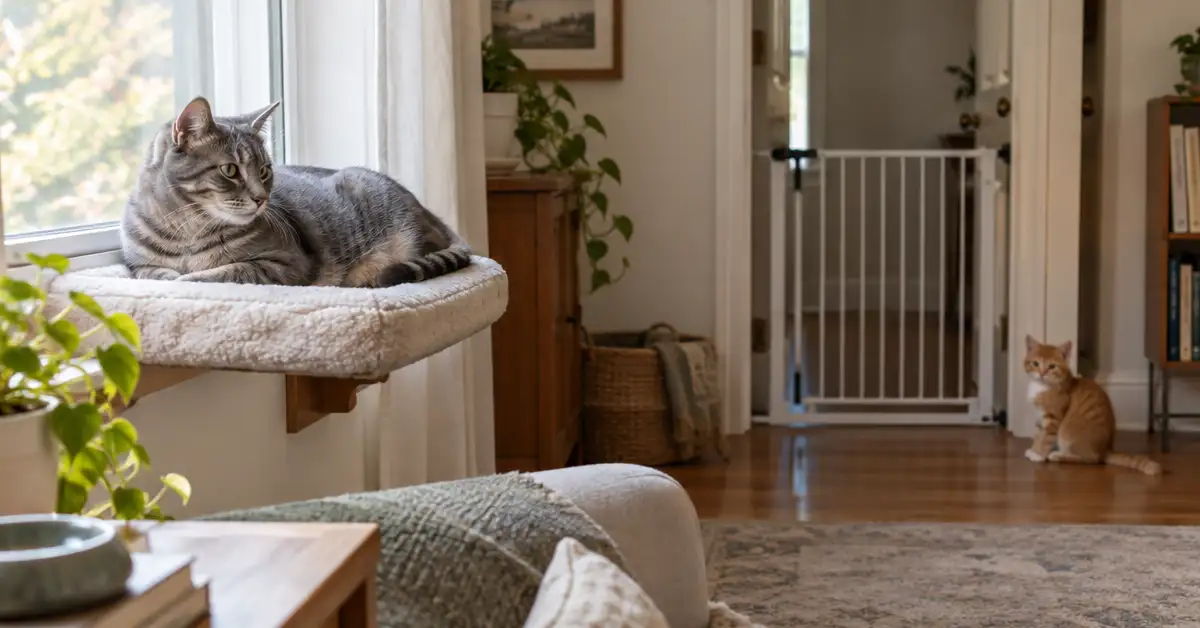
The American Association of Feline Practitioners (AAFP) and International Society of Feline Medicine (ISFM) environmental guidelines describe cats as territorial animals whose sense of safety depends on predictable access to key resources: food, water, litter boxes, resting places, scratching surfaces and elevated perches. Cats mark their space with scent from glands on their cheeks, paws and flanks, and that familiar scent profile is part of what tells them an area is safe. A new cat arriving suddenly disrupts all of this at once.
Cornell Feline Health Center’s guidance on aggression notes that territorial aggression often starts when a new cat is introduced without a gradual process. It recommends confining the newcomer to its own room and building familiarity in stages. Veterinary and welfare sources, including VCA Animal Hospitals and ASPCA Pet Health Insurance, give the same warning: a rushed first meeting can trigger fear and fighting. Once two cats have had a serious fight, it becomes much harder for them to learn that the other cat is safe. A few extra weeks spent on a careful introduction costs far less than trying to repair a relationship that started badly.
How to Introduce a New Cat, Step by Step
The stages below follow the sequence described by International Cat Care, VCA Animal Hospitals, American Humane and the SPCA of Wake County. The pace is set by the cats’ behavior, not the calendar. Move to the next stage only when both cats are eating normally, using their litter boxes and resting calmly at the current one. If either cat hisses, growls, stops eating or hides, go back a step.
1. Set up a separate “base camp” room for the new cat
Before the new cat arrives, prepare a room the resident cat doesn’t rely on, such as a spare bedroom, bathroom or laundry room. Stock it with food, water, a litter box, a scratching post, a bed, toys and somewhere to hide. International Cat Care and ASPCA Pet Health Insurance both advise that these items be new or already belong to the new cat, so they don’t smell of the resident cat. The new cat stays in this room with no visual contact with the resident. VCA suggests several days for a new adult cat to settle, and longer is fine. The goal is a newcomer that eats, uses the litter box, sleeps and explores its room normally. Keep giving the resident cat its usual attention and routine during this period.
Before any introduction, have the new cat seen by your veterinarian, and make sure your resident cat’s routine veterinary care is current. Your vet can advise on what that should include.
2. Swap scents before the cats ever meet
Cats rely far more on smell than on sight when they size each other up, so the first introduction is to each other’s scent. International Cat Care suggests taking a piece of each cat’s bedding and placing it in the other cat’s bed, so each cat gradually lies on the other’s scent. Over time the two scents mix into a shared “group” smell. The SPCA of Wake County suggests gently rubbing a soft cloth on one cat’s cheeks and placing it under the other cat’s food bowl, so the new scent is linked with mealtimes. You can also let the cats take turns exploring each other’s areas while the other is shut away elsewhere. Cornell describes this kind of room-switching as part of a gradual introduction.
If either cat avoids, hisses at or scratches at the swapped bedding, keep swapping at this stage for longer before moving on.
3. Feed the cats on either side of a closed door
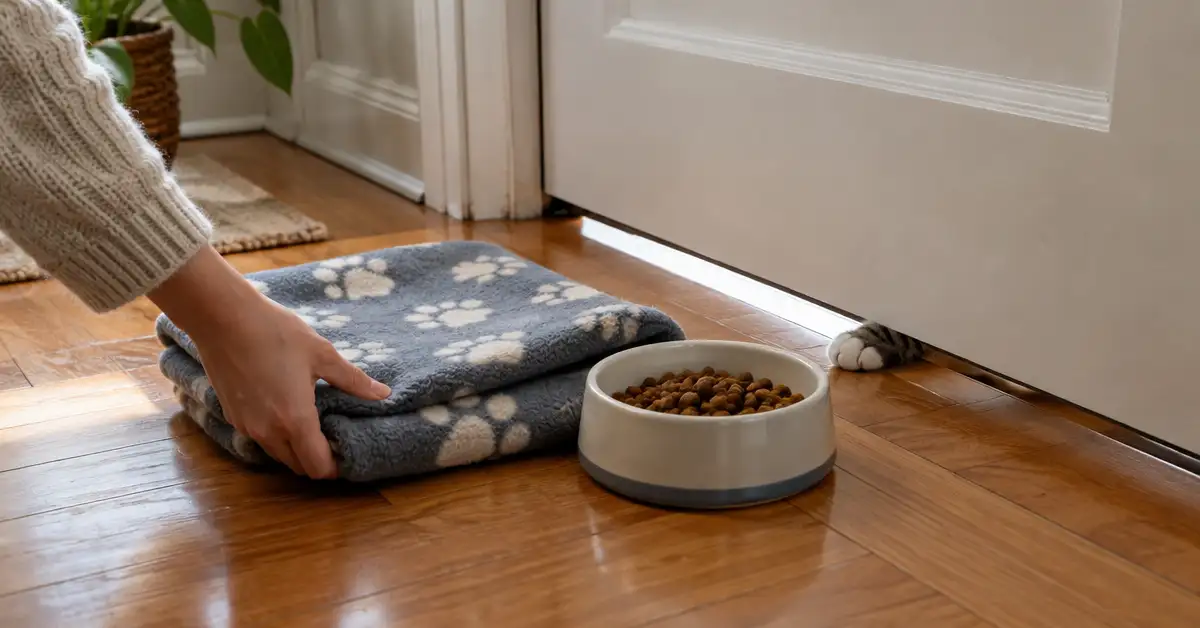
Next, feed both cats on opposite sides of the closed door to the new cat’s room. American Humane and the SPCA of Wake County both describe starting with the bowls far enough from the door that each cat eats comfortably. Then move the bowls a little closer over successive meals until both cats eat calmly right next to the door. Food is a strong positive experience, so pairing it with the other cat’s sounds and smell teaches each cat that the other’s presence predicts something good. If either cat growls or hisses through the door, American Humane’s advice is to slow down and keep feeding at a comfortable distance for as long as it takes.
4. Let them see each other through a barrier
When door feeding is calm, let the cats see each other without being able to reach each other. Use a sturdy pet gate across the doorway, a door propped open a few inches, or a screen. VCA suggests keeping both cats occupied with food or a toy during these sessions and watching for signs of stress. International Cat Care describes the goal as two cats who can go about their business, glancing at each other occasionally but not staring. If you see staring, flattened or rotated ears, a tense body, hissing or growling, calmly call the cat away or close the door. Never punish the cat.
One caution: advice based on International Cat Care’s approach notes that some cats feel pressured to approach a cat they fear in order to reach food. If a cat seems torn between the food and keeping its distance, move the food further back.
5. Supervised time together, then gradually more
Once both cats are consistently relaxed at the barrier, open it for short supervised sessions in a room where each cat has space to move away and somewhere high to escape to. VCA recommends timing early meetings for when both cats are distracted, such as mealtimes or play. Stay close enough to calmly separate them at the first sign of tension, before a fight starts. Keep sessions short, end them on a calm note, and return the new cat to its room between sessions. International Cat Care recommends starting unsupervised time with just a few minutes and building up only while both cats stay comfortable. Eventually the base-camp door can stay open and the cats can come and go.
Expect some hissing along the way. A single hiss is communication, not failure. Chasing, stalking, ambushing or a real fight means you have moved too fast. Go back to the barrier stage and rebuild from there.
How Long Does It Take?
The SPCA of Wake County says introductions can take anywhere from a few days to a few weeks, or even a few months, depending on the cats. Cornell notes that working through territorial tension can take weeks to months. Neat day-by-day schedules found online are not in the primary guidance. A realistic expectation is days to weeks, sometimes months. The cats’ behavior tells you when to move on.
Introducing a Kitten to an Older Cat
This is the most common introduction, and there is some good news. The AAFP/ISFM environmental guidelines note that it is generally easier for adult cats to accept kittens than to accept other adult cats, likely because a kitten is less of a territorial threat. The step-by-step process above still applies. What changes is where the risk lies. It is usually not that the older cat will attack the kitten. It is that the kitten’s constant pouncing and invitations to play will wear down, frustrate or frighten an older cat until it starts swatting and growling.
The fix is to protect the older cat’s ability to opt out:
- Give the older cat high places and private rooms the kitten can’t easily reach or follow into. The AAFP/ISFM guidelines recommend resting spots with more than one way in and out, so one cat can’t trap another. This matters even more for a less agile senior.
- Keep the older cat’s routine, including feeding times, favorite spots and one-on-one attention, as unchanged as you can.
- Tire the kitten out yourself. Regular interactive play sessions burn off the energy that would otherwise be aimed at the older cat.
- Let the older cat set the pace. Cornell advises rewarding brief, calm interactions and ending contact at the first sign of irritation. Apply the same principle to kitten-and-older-cat time.
Introducing Two Adult Cats
Two adults usually need more patience, because each sees the other as a possible competitor for space and resources. VCA’s guidance is written for new adult cats and stresses proceeding slowly and gradually through every stage. If you haven’t adopted yet, American Humane and the SPCA of Wake County both suggest choosing a cat whose personality and activity level are similar to your current cat’s. A high-energy young adult and a quiet, settled cat can struggle to understand each other.
Adding a Cat to a Multi-Cat Home
With three or more cats, the household may contain more than one social group, and a new cat may get along well with one resident and only tolerate another. International Cat Care recommends introducing the newcomer to one resident cat at a time rather than to the whole group at once. The AAFP’s 2024 intercat tension guidelines recommend spreading resources throughout the home so no cat has to pass another to reach essentials. That means separate feeding and water stations out of each other’s sight, litter boxes in several locations, and more safe resting places. For litter boxes, the widely used rule is one per cat plus one extra. Our guide to how many litter boxes you should have covers placement in detail, and our picks of the best litter boxes for multiple cats focus on boxes suited to shared homes.
Setting Up Your Home to Help
Home layout is part of the introduction, not an extra. The AAFP guidance comes down to a few principles:
- Separate resources. Keep food, water and litter boxes in their own locations, and have several of each rather than one shared station.
- Vertical space. Cat trees, shelves and window perches add escape routes and lookout points, which reduce the feeling of being cornered.
- Hiding places with two exits, so a cat can get away without being trapped.
- Scratching posts in each cat’s area. Scratching leaves scent from the paw pads and helps each cat feel that a space is theirs.
- Keep the home’s scent stable. Avoid strong new cleaning products or scented litter during an introduction.
Some owners also use a synthetic feline pheromone diffuser or spray. VCA notes these may help reduce signs of stress when used alongside a gradual introduction. They support the process but cannot replace it. Separate feeding stations and a sturdy pet gate are the other practical tools most introductions use. Our cat gear guide covers the everyday equipment a multi-cat home runs on.
When Things Aren’t Going Well
If the cats keep hissing, growling or chasing, the process is almost always moving too quickly, or there aren’t enough resources to go around. Cornell’s advice is to increase the distance again and repeat earlier steps until both cats are calm. The SPCA of Wake County notes that after repeated fights you may need to restart the introduction from the beginning. Also check the home for bottlenecks. A cat sitting in a doorway or next to the litter box may be quietly blocking the other cat, and adding a second route or another resource elsewhere can ease the tension.
If a fight breaks out, never reach in with your hands or pick up one of the cats. Cornell and the SPCA of Wake County both warn about the risk of serious injury to you. Instead, make a sudden noise or slide a barrier, such as a cushion, a piece of cardboard or a baby gate, between them. Guide them into separate rooms and leave them apart until both are completely calm. Don’t try to comfort a cat that is still aroused, because it may lash out at you. Then go back several steps in the process.
Avoid punishment. ASPCA Pet Health Insurance and Cornell both advise against yelling, spraying water or other punishment, because it raises the cats’ stress and can make territorial behavior worse.
Talk to your veterinarian, or ask for a referral to a veterinary behaviorist, if a cat is injured, if fights keep happening despite a slow introduction, if a cat stops eating or hides for long periods, if a cat starts going outside the litter box, or if there is no improvement after several weeks of careful work. Your vet can look at the whole picture and advise on next steps.
Finally, keep your expectations realistic. International Cat Care and the AAFP both note that cats who simply share the house calmly, resting in the same room and taking turns at resources, have a successful relationship even if they never groom or cuddle each other. Peaceful coexistence is a good outcome.
Frequently Asked Questions
Methodology & Sources
This guide is research-led, not based on hands-on veterinary or professional behaviorist practice. It summarizes published guidance from veterinary and welfare organizations and does not draw on first-hand trials. Michael Probert, our author, is a longtime multi-cat owner writing from research and lived experience. See our About page. We have no in-house veterinary reviewer. The information here is general and not a substitute for advice from your veterinarian or a certified feline behaviorist. Full editorial policy: How We Choose.
Sources: AAFP and ISFM Feline Environmental Needs Guidelines (2013), 2024 AAFP Intercat Tension Guidelines, Cornell Feline Health Center, VCA Animal Hospitals, International Cat Care, American Humane, SPCA of Wake County, and ASPCA Pet Health Insurance.
Getting ready for a new arrival? See our guide on how to get your cat into a carrier for the trip home, and our full cat gear guide for everything a new cat needs.