Updated for 2026. A cat water fountain only helps your cat drink more if it’s actually clean. Left too long, fountains develop biofilm (“pink slime”), limescale, and saturated filters that make water taste off — which can drive a cat back to the sink or, worse, off water altogether. This guide covers how often to clean a fountain, a full step-by-step deep-clean routine, how to descale and care for the pump, how to prevent and remove slime and mold safely, and the warning signs that mean your fountain needs attention right now.
This is general information for cat owners, not veterinary advice. We have no in-house veterinary reviewer. If your cat suddenly stops drinking, seems unwell, or shows signs of dehydration, please contact your vet.
How Often Should You Clean a Cat Water Fountain?
The ASPCA and the CDC both recommend washing pet water bowls at least once a day and sanitizing them weekly — in a fountain, that translates into daily basin refreshes plus a genuine weekly teardown, since a recirculating reservoir hides debris a simple bowl never would. Filters typically need replacing every 2–4 weeks, and pump descaling is worth doing every 4–8 weeks (more often with hard water). None of these numbers are strict rules from controlled trials — they’re a synthesis of veterinary, public-health, and manufacturer guidance — so treat them as a sensible starting point you can adjust for your household.
| Task | Frequency | Why |
|---|---|---|
| Replace visible water in the basin | Daily | Freshness, reduces biofilm and odor |
| Wipe accessible surfaces, remove debris | Daily | Prevents early slime and pump clogging |
| Full disassembly and scrub | Weekly | Removes biofilm in hidden areas, protects the pump |
| Rinse foam pre-filter | Weekly | Keeps debris out of the pump intake |
| Replace carbon/multi-stage filter | Every 2–4 weeks | Maintains taste/odor control, avoids saturation |
| Pump descaling (vinegar soak) | Every 4–8 weeks (more in hard water) | Controls limescale, prevents noise and flow loss |
Step-by-Step Deep Cleaning
Do this weekly at minimum. Always unplug the fountain first — never operate it partially disassembled, and never submerge the pump’s power adapter or any control electronics.
1. Unplug and gather your tools
Unplug the fountain (or remove batteries on cordless models) before touching any part of it. Have a soft brush, a bottle brush for narrow channels, a couple of non-abrasive cloths, and a cotton swab or two ready. Avoid abrasive scrubbers — microscopic scratches give biofilm more surfaces to grip. If you have one, keep the manual handy so you know which parts are dishwasher-safe.
2. Disassemble the fountain
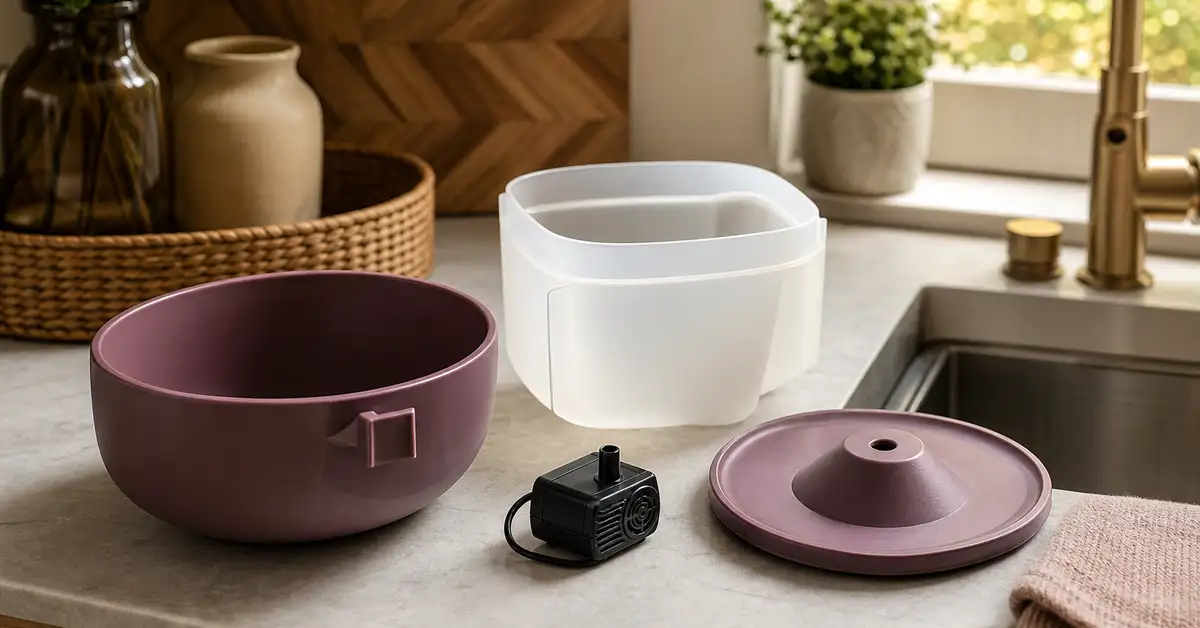
Remove the top cover or spout, lift out the basin, and detach the reservoir. Most pumps sit on suction cups or clips and connect via short tubing — note the orientation before pulling them apart. Take out the filter and set it aside (replace it now if it’s due). Keep small gaskets and O-rings together on a towel so nothing gets lost before reassembly.
3. Wash the dishwasher-safe and hand-wash parts separately
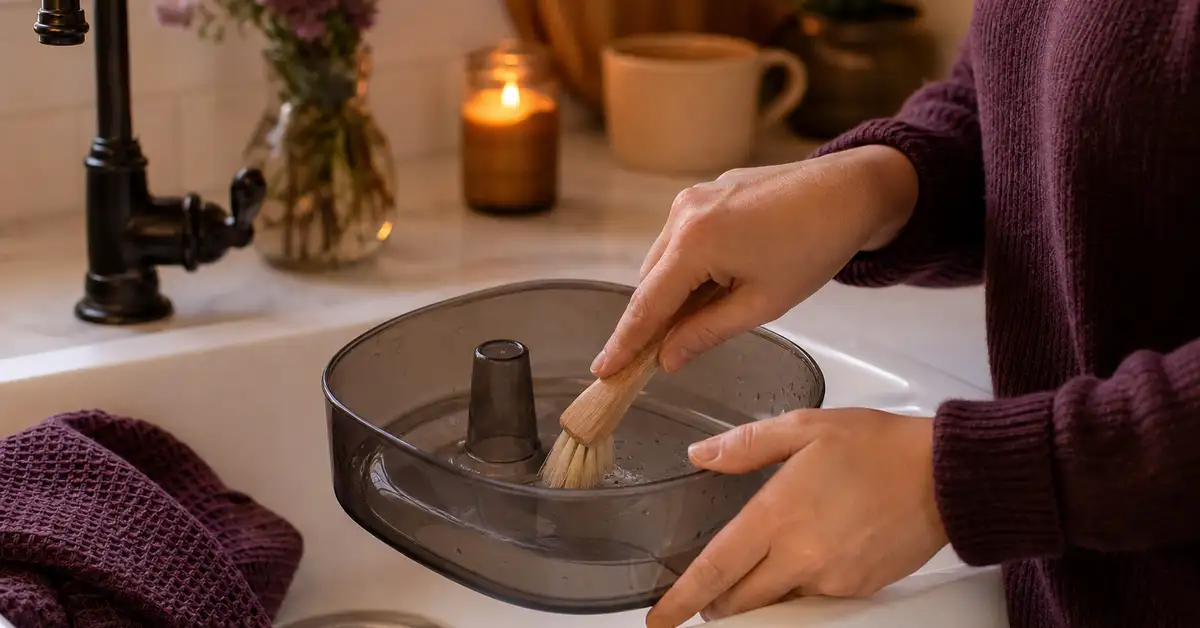
Basins, covers, and reservoirs are dishwasher-safe on many models — check your manual. Hand-wash everything else with warm water and a mild, unscented dish detergent, scrubbing away any slime or residue. Never put the pump housing, power adapter, or any electronic components in a dishwasher or submerge them beyond what the manual specifically allows.
4. Clean and descale the pump
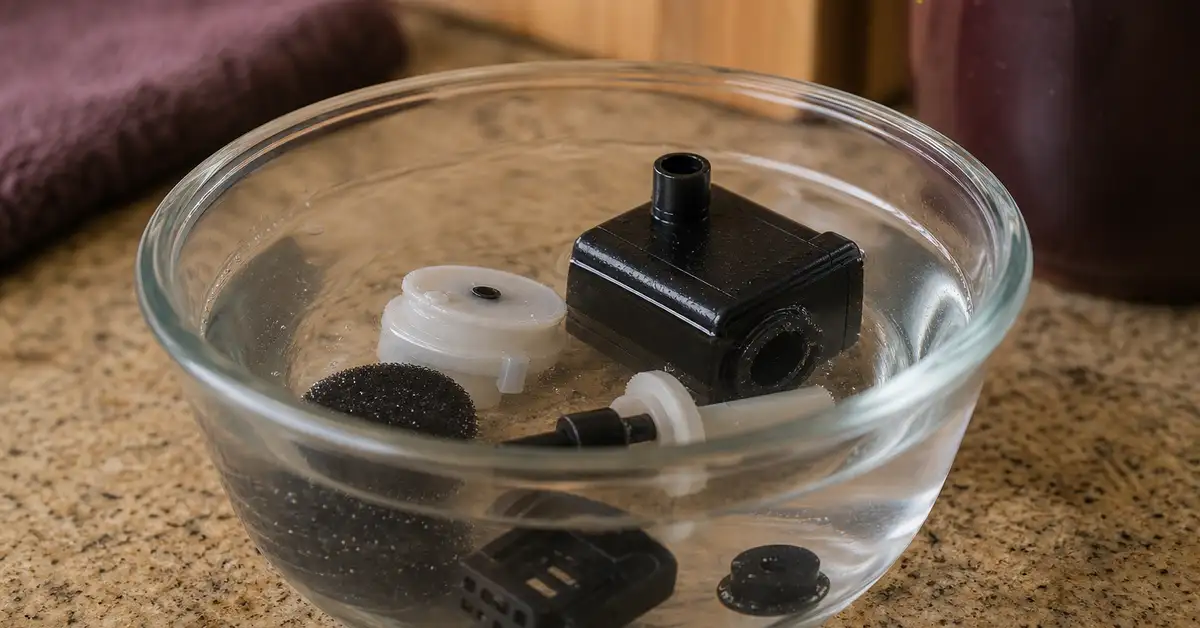
Most pump faceplates snap off without tools, exposing the impeller, which lifts straight out since it’s held only by magnetism. Soak the housing, faceplate, and impeller in a vinegar-and-water solution (roughly one part white vinegar to two parts water, or up to a 50/50 mix for heavier scale) for 20–30 minutes — no longer, since plastic can start absorbing the vinegar smell. Use a vinegar-dipped cotton swab to scrub inside the impeller shaft, where limescale concentrates most, and remove any hair wrapped around the base pin with tweezers.
5. Rinse everything thoroughly
Rinse every component under running water until no soap or vinegar smell remains — at least 60 seconds per piece for pump parts. This step matters more than it sounds: cats are sensitive to taste and smell, and leftover detergent or vinegar residue is a common, avoidable reason cats start avoiding a freshly cleaned fountain.
6. Reassemble, refill, and restart
Let parts air-dry where possible, then reassemble in reverse order — the impeller drops back into its shaft and seats magnetically, and the faceplate snaps back into place. Refill with fresh water, plug the fountain back in, and watch it for a few minutes to confirm normal flow with no leaks or new noises. If your cat is hesitant around the just-cleaned fountain, that’s normal — give it a little time, and check for residual odor or an unusual pump sound if the hesitation doesn’t pass.
Removing and Preventing Limescale
Limescale is the chalky, whitish mineral buildup (mostly calcium carbonate) that forms from hard water. In a fountain, it typically shows up on the basin, spout, and — most importantly — the pump impeller and housing, where it can cement onto the impeller magnet and cause grinding noise, reduced flow, and eventually pump failure. White vinegar’s acetic acid dissolves it effectively: a 1:2 vinegar-to-water solution works for lighter buildup on bowls and basins, while a stronger 50/50 mix suits heavier scale on pump parts, soaked for 20–30 minutes.
If you’re in a hard-water area (water hardness above roughly 120 ppm), plan on descaling every 2–3 weeks rather than the standard 4–8, and inspect the pump more often for early chalky roughness. Some owners switch to filtered or bottled water to reduce mineral load, though this is optional and not necessary for most households — it’s a preference, not a requirement.
Pump Care: Cleaning, Descaling, and When to Replace
Noise is usually the first sign of pump trouble, often arriving before any visible drop in flow. A grinding or chalky feel when you spin the impeller by hand points to limescale on the magnet — clean and descale as above. A sudden high-pitched buzz that follows a period of running dry can mean the impeller shaft has warped from heat and friction; if a full clean and vinegar soak don’t resolve persistent grinding or buzzing, the pump has likely reached the end of its service life and needs replacing. Running the pump dry is one of the most common and most preventable causes of early pump failure, so keeping the water level topped up daily matters as much as the weekly deep clean.
If a fountain shows no power at all, it’s worth testing the adapter with another compatible device before assuming the pump itself has failed — a dead adapter is a common and easily overlooked cause that doesn’t require replacing the whole unit.
Preventing Mold, Biofilm, and Pink Slime
The pink or reddish film that sometimes appears on pet fountains and dishes is a biofilm, most often built around the bacterium Serratia marcescens along with mold and yeast that thrive in damp, nutrient-rich spots — the same organism responsible for the pink film that shows up in bathrooms. It isn’t typically a serious health risk for healthy cats or people, but it’s unpleasant, it can put a cat off drinking, and it’s genuinely easy to prevent. Algae is a second common culprit, especially in fountains that sit in direct sunlight — the ASPCA specifically recommends keeping pet fountains out of direct sun for this reason.
Prevention is mostly about denying biofilm what it needs: routine weekly scrubbing (not just rinsing) to physically disrupt any slime before it establishes, keeping the fountain out of direct sunlight, and avoiding letting food residue or standing water sit for days. If slime has already formed, hot soapy water and firm scrubbing usually clears it; a diluted bleach solution (about 2 oz of bleach per gallon of water, soaked 10+ minutes, then rinsed thoroughly) or a vinegar soak can help with more stubborn buildup, but bleach should be reserved for non-pump components you can rinse completely, since residue can affect both taste and material safety.
Filter Care
Most fountains combine a mechanical filter (foam or mesh, catching hair and debris) with an activated carbon stage that improves taste and odor. Carbon filters can’t be washed and restored — once saturated, they stop adsorbing effectively and can even start releasing trapped compounds back into the water, which is a common, overlooked reason a cat suddenly stops using a fountain it used to like. Replace carbon filters every 2–4 weeks as a baseline, sooner in multi-cat households or if you notice odor, discoloration, or reduced flow. Foam pre-filters can usually be rinsed under running water (no soap) weekly to extend their life between full replacements.
Filter recycling isn’t well standardized across brands — most end up in regular household waste, since they combine plastic housings with carbon media that most municipal recycling programs won’t accept. If this matters to you, it’s worth asking the manufacturer directly about take-back programs.
Placement Tips That Reduce Cleaning Frequency
Where you put the fountain affects how often it needs cleaning. Keep it out of direct sunlight to slow algae growth, and away from the litter box, since cats instinctively avoid drinking near where they eliminate and proximity can also mean more tracked debris in the water. Somewhere your cat finds calm and easily reachable — not a cramped corner you’ll be tempted to skip when cleaning day comes around — makes the weekly routine easier to actually keep up with. For senior cats or homes with mobility issues, keep the fountain on the same floor the cat spends most of its time on, and skip elevated placements that require jumping.
Signs Your Fountain Needs Cleaning Right Now
- Cloudy or turbid water — suggests suspended particles or microbial growth; replace the water and check the filter and basin immediately.
- Any noticeable odor — musty, sour, or chemical smells mean biofilm or a saturated filter, not something to wait out.
- Visible slime — pink/reddish (bacterial), green (algae), or a general film all call for a full deep clean, not just a wipe-down.
- White chalky residue — limescale on the basin, spout, or pump housing; descale before it affects flow.
- New grinding, buzzing, or rattling noise — usually scale or debris on the impeller; clean and descale before assuming the pump has failed.
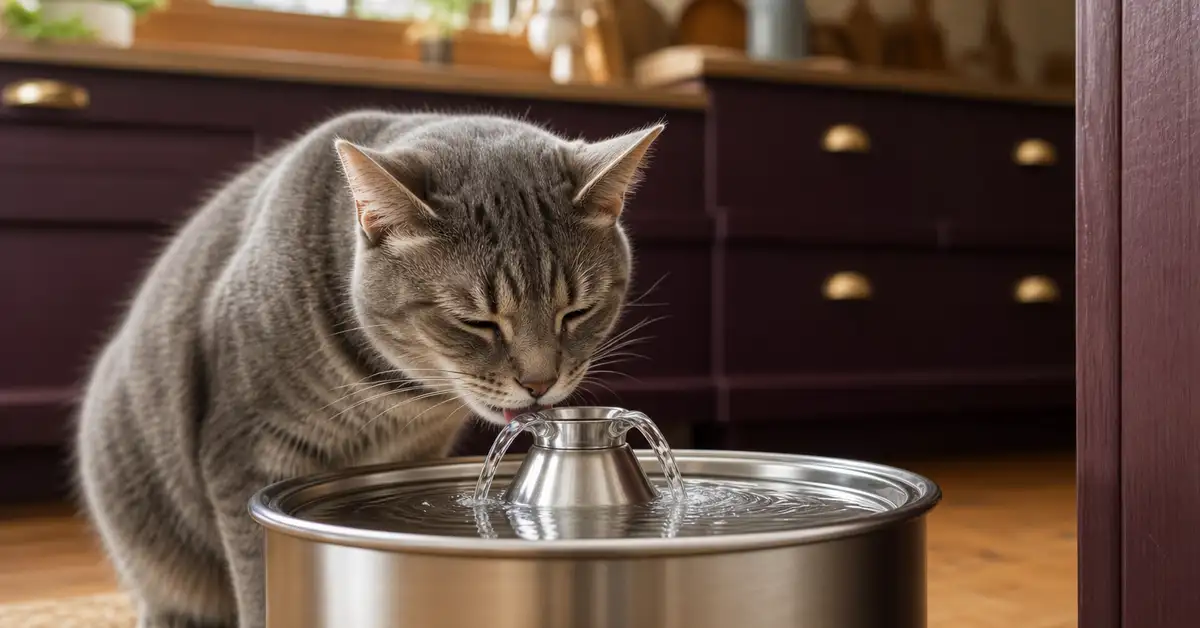
- Your cat starts avoiding the fountain — often the earliest and most reliable signal something about the water or fountain condition has changed, even before you can see or smell it yourself.
If your cat’s drinking changes dramatically — much more, much less, or alongside other symptoms — that’s worth a vet visit rather than assuming it’s the fountain. We cover that in more depth in our guide to why cats don’t drink enough water.
Frequently Asked Questions
Methodology & Sources
This guide is research-led, not based on hands-on veterinary or pump-repair practice. Michael Probert, our author, is a longtime multi-cat owner writing from research and lived experience — see our About page. We have no in-house veterinary reviewer; health-related information here is general and not a substitute for professional veterinary advice.
Sources: PetMD, Cornell Feline Health Center, ASPCA, AAHA, Cats.com, Cleveland Clinic, EPA (Biofilms in Drinking Water), CDC, VCA Animal Hospitals, and manufacturer maintenance guidance.
See our full cat water fountain buying guide, our picks for stainless-steel fountains and ceramic fountains, and our guide to fountains for multiple cats.